
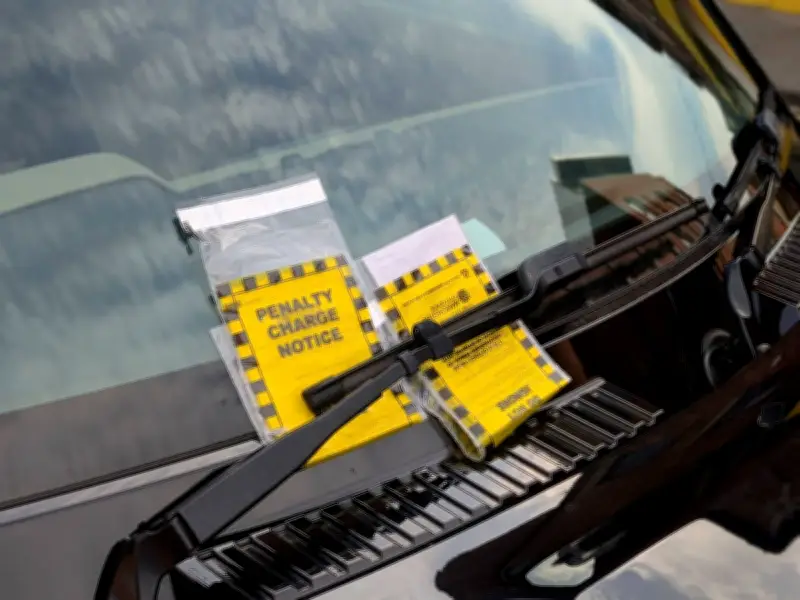
Mortgage brokers have warned that unpaid parking fines can escalate into County Court Judgments (CCJs), turning straightforward mortgage applications into costly specialist lending proposals. Record numbers of parking tickets are being issued, and experts urge drivers to pay fines and dispute them through proper channels rather than ignore them.
Record parking fines
RAC analysis of government data shows that in the year to the end of September 2025, a record 15.9 million parking tickets were handed out by private firms, 17% more than the same period the previous year. The RAC expects the number of private parking tickets issued in the year to the end of March 2026 to hit a new record of 17 million. Brokers say they now regularly deal with the fallout.
Jamie Elvin, director at London-based Strive Mortgages, said: "It feels like there has been an explosion in private parking firms in recent years." He added: "We're now regularly coming across situations where a relatively minor unpaid parking ticket is causing a disproportionately expensive mortgage problem. Once an unpaid parking fine or bill turns into a default or CCJ, lenders are no longer interested in the principle of the dispute — they just see adverse credit."
Impact on mortgages
Elvin explained that a CCJ can mean fewer lenders, higher rates or a declined application altogether: "The real irony is that someone can have a strong income, significant assets and still end up paying more for years because they took a stand over a comparatively small amount. If a bill is wrong, challenge it properly — but don't ignore it, because the mortgage market is far less interested in who was right than whether the debt was left unresolved."
Darryl Dhoffer, founder of Bedford-based The Mortgage Geezer, said he recently dealt with a case where a high-net-worth individual experienced the problem first-hand: "The higher the net worth, the fiercer the moral high ground can become. It's a trend I see often with high-earning business owners who let pride derail their finances over a petty dispute. I had a client recently, who was a wealthy multi-company owner. He ignored a minor parking fine and didn't pay it. That quickly escalated into a County Court Judgment. Still, he ignored it. The backfire came when he needed a mortgage. What should have been a straightforward high-street mortgage application turned into a specialist lending nightmare. Because of that unpaid CCJ, major banks slammed their doors. He was forced into the specialist market, facing significantly higher interest rates and thousands in extra costs."
Common causes and advice
Emma Jones, managing director of Runcorn-based WhenTheBankSaysNo.co.uk, said parking-related CCJs are a surprisingly common reason buyers are declined, particularly by lenders that rely heavily on automated underwriting systems: "We see cases like this far more often than people realise. A relatively small parking fine can snowball into a CCJ if it's ignored or forgotten, and once that appears on your credit file it can trigger an automatic mortgage rejection. Most high street lenders will say 'no' if you have a CCJ. But one lender saying no doesn't mean every lender will. There are specialist lenders who are prepared to look at the whole picture, including why the CCJ happened, how long ago it was, whether it's been satisfied and how the applicant has managed their finances since."
Ben Perks, managing director of Stourbridge-based Orchard Financial Advisers, said parking fine-related mortgage issues are "a regular occurrence" at his firm, as "parking companies won't hesitate to slap you with a CCJ". He added: "It's frustrating, especially if you believe you're in the right, but ultimately it may not be worth the row. There are lenders that are more lenient and will ignore a parking CCJ, so it might not scupper your chances of buying, but it'll certainly mean you're paying more a month. My advice is get these things dealt with asap. Don't bury your head in the sand."
Martin Rayner, financial adviser at Compton Financial Services, said administrative oversights rather than principles could often be the cause of a CCJ: "The most common example we see is parking fines and motoring penalties being sent to an old address after someone has moved home. The correspondence is missed, the debt escalates and what started as a relatively minor charge can ultimately result in a CCJ. In many cases, the first time the individual becomes aware of it is when they apply for a mortgage. The irony is that the original debt is often tiny compared with the consequences. A small parking fine can restrict mortgage options or even prevent someone from obtaining a mortgage. A £60 fine can end up costing thousands in extra interest payments on a mortgage. The simplest advice is to update both your driving licence and vehicle logbook (V5C) whenever you move house."
Aaron Strutt, product and communications director at London-based Trinity Financial, said his firm had seen a lot of parking fine-related issues over the years: "Many borrowers would rather not pay the bill because they think it is so unfair. The issue is that their credit can take a significant hit, and they end up paying more for years. Missed payments often transfer automatically to the credit reference agencies, and red marks are put on credit files pretty quickly. Having a CCJ is often pretty disastrous when it comes to qualifying for a cheap mortgage rate. It is often easier to pay the debt and then try to get it back through the normal complaints procedures if you have a mortgage or want to apply for a mortgage in the future. Finding out that you can't get a cheap fixed rate or a best buy tracker mortgage is often even more stressful than the initial fine."
Nouran Moustafa, director at Roxton Wealth, added: "Fight a bill if it is genuinely wrong, absolutely. But keep it documented, respond to every letter, use the formal complaints route and never ignore court paperwork. Principle is expensive when it damages your borrowing power."




