
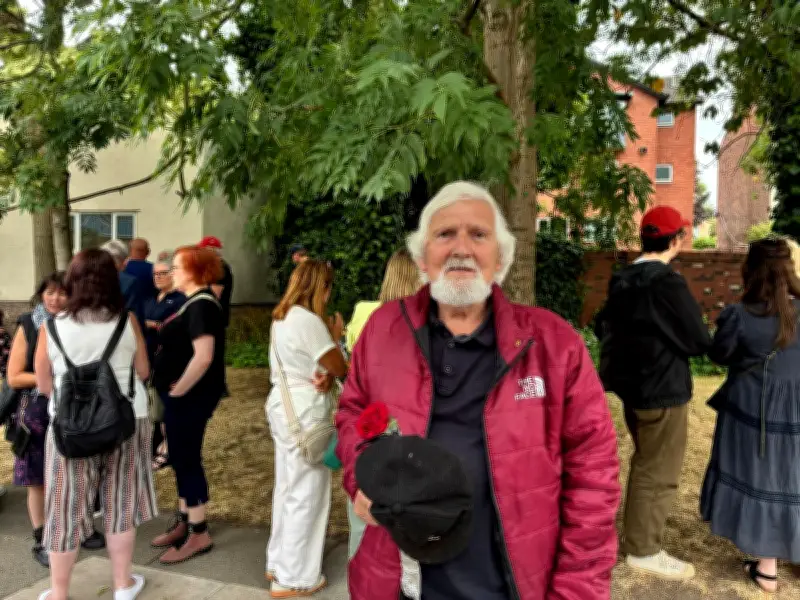
Kenneth Clarke, 82, was one of the last people to see Diane Sindall alive before she was murdered in the early hours of August 2, 1986. The former taxi driver says the memory "lives with him all the time".
On Sunday, Mr Clarke laid flowers at a memorial to Diane as people gathered in Birkenhead to mark 40 years since her death. The memorial records how the 21-year-old was killed "because she was a woman".
Sighting on Borough Road
Diane, a florist who had taken a part-time pub job to save for her wedding, was driving home from a shift when her car ran out of petrol on Borough Road. She was seen by at least three witnesses, including Mr Clarke, walking along the road between midnight and 12.20am. Her body was found several hours later by a member of the public in a nearby alleyway.
Mr Clarke, then 42, saw Diane close to where the memorial now stands. He told the ECHO: "I had just dropped off my fare and came around the roundabout that used to be there when I saw her." He later recognised her from descriptions, noting she was wearing jeans and a light top with spots on it. He considered offering her a cab but did not, fearing he would be breaking his contract and needing to support his wife and children. "But I started thinking that I would be breaking my contract, and I had a wife and kids to support, so I didn't. That's there all the time. A minute later, she was gone. I don't know where she went. I've got that memory all the time, and I've had to live with what happened that day. This has been a hard day every year since."
'Because she was a woman'
The murder sparked a movement in Birkenhead. Local women raised funds for a memorial stone that tells how Diane was killed "because she was a woman", and a group of young mothers organised a march of hundreds of women and girls through Birkenhead to "reclaim the night".
A crowd gathered around the memorial stone on Sunday evening in quiet reflection, laying flowers and candles. Women shared their memories of the time. The event was organised by RASA Merseyside, a charity set up in the months following Diane's death to support survivors of sexual violence.
Organiser Jo Wood said: "We want to mark this day because there has been so much said in recent months after Peter Sullivan was released. We want to mark that a beautiful young woman died, and we need to put Diane back at the centre of what happened here. We also want to remind people: someone out there, in this community, knows something. I can't begin to imagine what that would mean to Diane's family."
Wrongful conviction and exoneration
Peter Sullivan served 38 years in prison for Diane's murder before DNA evidence exonerated him in May 2025.
Yvonne Nolan, 75, was a local councillor at the time and helped organise the women's march as well as campaigning for better street lighting. She said 500 people marched that evening. She told the ECHO: "It was important that there were so many women there. It had such an impact. It made women feel they were not alone, it made us feel stronger. But there are still so many women murdered because they are women. 40 years ago, we hoped we could stop the violence against women and girls, but that's not what has happened. With misogynistic influencers like Andrew Tate around, we are going backwards. Those words inevitably lead to violence."
Remembering the march, she said: "It was Easter time, and just before the march it snowed. A lot of the women wore light tops and short skirts, how we should have been able to dress without fear, and they must have been frozen."
Those who organised
Becky Jones, 49, recalled the group of women meeting at her mother's house in Wallasey to organise the march. She said: "What these young mums were doing was amazing for a young girl. It was all about reclaiming the night and it was so empowering."
Vicky Hunter, 79, raised the funds for the memorial stone and wrote the words "because she was a woman". She said: "This is still happening today. Not enough has changed, and that's why it's important that we gathered here today to remember."
Addressing the crowd, Jo Wood also acknowledged other victims of the crime, including Diane's family, the wrongfully convicted Mr Sullivan, and his family.
'The most horrific murder crime'
John Thompson, a former ECHO reporter who covered the murder and trial, attended the memorial. He said: "It immediately struck fear into the community of Birkenhead and beyond, with ripple effects reaching out to Cheshire, over the Mersey, and into Liverpool. It was the most horrific murder crime you could ever imagine."
He spoke of the fateful circumstances: "a young woman running out of petrol at midnight on the threshold of her life, from a lovely family not far from here". He said the violence made clear it was an out-of-the-ordinary murder, and "very quickly there was a monster on the streets that needed capturing, and it didn't happen immediately".
Women were scared to walk the streets, and people would pick up women from schools, offices, factories and shops to drive them home. "The community was gripped with genuine, understandable fear," he said. He also noted the Sullivan family: "They are victims of this too. I met Peter Sullivan's family in their home before the trial, and they were rocked as well. To their credit, they never stopped believing Peter was innocent, which has now been proven. Perhaps too late, but at least his name is clear."




