

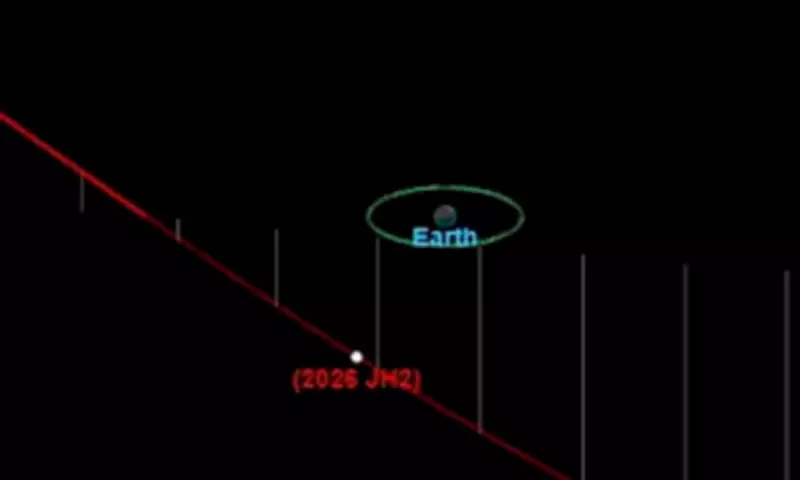
An asteroid with the potential to obliterate a city will narrowly miss Earth next week, scientists have revealed. Astronomers say the space rock, designated 2026 JH2, is up to four times the size of a London bus and will come exceptionally close to our planet.
Close Approach Details
The asteroid is expected to zoom by Earth at an estimated distance of around 56,000 miles (90,000 kilometres) late on Monday night. This is exceptionally close, equivalent to just a quarter of the distance between Earth and the Moon. Despite having enough mass to wipe out a city, it was only identified by observatories a few days ago, raising concerns about the early detection of potentially hazardous asteroids.
Size and Speed
Estimates place the size of the space rock between 52 and 115 feet (16 to 35 metres) in diameter. As it passes by, it will be travelling at 5.17 miles per second relative to Earth. 'It's the kind of thing that would ruin a city quite efficiently, if it hit,' said Mark Norris from the University of Lancashire.

Thankfully, simulations suggest there is no chance of an impact for at least the next 100 years. The size of the asteroid is an estimate based on the amount of light reflecting off its surface, meaning measurements cannot be entirely certain. If the asteroid is made of a particularly dark or unreflective material, it could be nearer to the higher end of the estimate range or potentially even larger.
Destructive Potential
Experts say if 2026 JH2 did strike Earth, it would cause an event comparable to the Chelyabinsk meteor. In 2013, an 18-metre (59-foot) meteor exploded over the city of Chelyabinsk in Russia. The resulting explosion was 30 times more powerful than the atomic bomb dropped on Hiroshima, producing a shockwave that travelled twice around the world. Directly beneath the explosion, 28 miles (45 kilometres) above the ground, the heat was so intense that people were left with burns and retinal damage. Around 1,500 people were injured and over 3,600 homes were damaged, even though only 0.05 per cent of the original rock reached the ground.
With a potential size up to 35 metres (115 feet) in diameter, 2026 JH2 has the potential to be even more destructive, possibly ranking it as a 'city killer' size asteroid. However, although the asteroid will pass extremely close to the planet, it poses no threat whatsoever to Earth.
Visibility and Current Location
While asteroid 2026 JH2 will be too faint to see with the naked eye, it may be visible through amateur telescopes under dark sky conditions. It is currently around 1.8 million miles (three million kilometres) from Earth in the constellation of Ursa Major.
Planetary Defence Concerns
Earlier this year, NASA's head of planetary defence revealed there are still tens of thousands of 'city killer' asteroids that remain undetected. Dr Kelly Fast, who leads efforts to find and track near-Earth objects, admitted they are still looking for around 15,000 mid-sized celestial bodies which could pose a threat. While an impact from one of these, defined by being at least 140 metres wide, would likely not destroy the planet, it could 'really cause regional damage'.
And it turns out Earth still has no way to deflect one if we realised it was heading straight for us. In 2022, NASA deliberately sent a spacecraft called DART 6.8 million miles into space to crash into a mini moon called Dimorphos at 14,000 mph in a bid to alter its orbit. This mission was hailed as a success, paving the way for defending our planet by knocking incoming asteroids off their set path towards Earth. But Dr Nancy Chabot, a planetary scientist at Johns Hopkins University who led that mission, said there are no other DART-like spacecraft ready to launch if an asteroid was suddenly found to be on a collision course with Earth. 'Dart was a great demonstration,' she said. 'But we don't have [another] sitting around ready to go if there was a threat that we needed to use it for.'
Potential Methods for Eliminating the Threat of an Asteroid
DART is one of many concepts of how to negate the threat of an asteroid that have been suggested over the years.

- Multiple bumps: Scientists in California have been firing projectiles at meteorites to simulate the best methods of altering the course of an asteroid. Results suggest that an asteroid like Bennu, rich in carbon, could need several small bumps to change its course. 'These results indicate multiple successive impacts may be required to deflect rather than disrupt asteroids, particularly carbonaceous asteroids,' researchers said.
- Nuke: Another idea, known simply as 'nuke', involves blowing up a nuclear explosive close to the asteroid. However, this could create smaller but still potentially dangerous fragments of rock that could spin off in all directions, potentially towards Earth.
- Ion Beam Deflection: With Ion Beam Deflection, plumes from a space probe's thrusters would be directed towards the asteroid to gently push on its surface over a wide area. A thruster firing in the opposite direction would be needed to keep the spacecraft at a constant distance from the asteroid.
- Gravity tractor: Another concept, gravity tractor, would deflect the asteroid without physically contacting it, but instead by using only its gravitational field to transmit a required impulse.
Professor Colin Snodgrass, an astronomer at the University of Edinburgh, said: 'There have been a few concepts suggested, such as a 'gravity tractor' to slowly tow an asteroid away instead of pushing it with a kinetic impactor. But the kinetic impactor is definitely the simplest technology to use on the sort of timescale that is most likely to be of concern for this size of asteroid, i.e. years to decades warning time.'





