
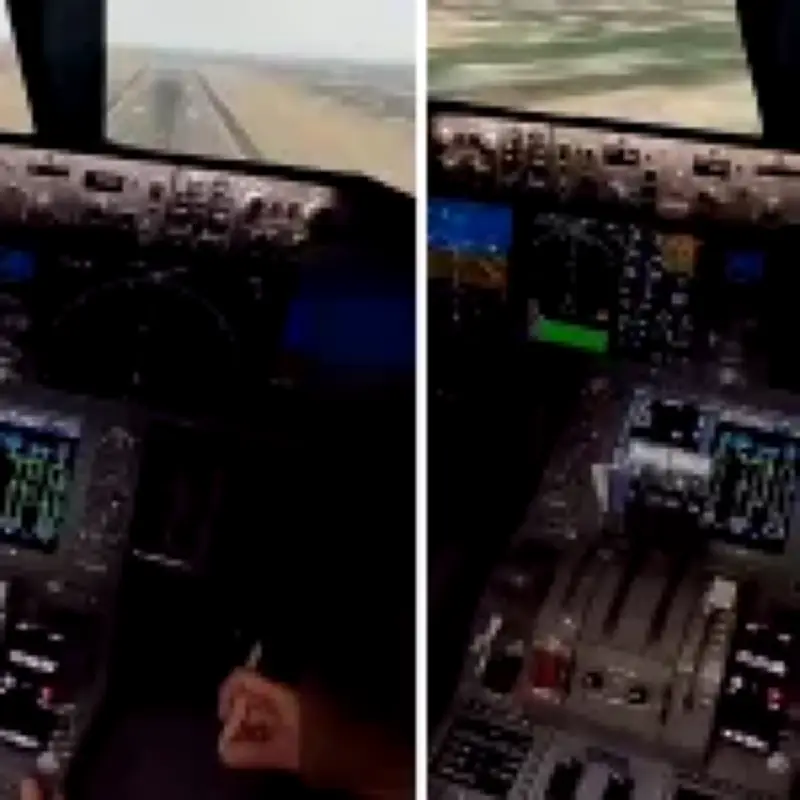
New footage from a law firm's simulation of the Air India crash has cast doubt on the theory that pilot suicide was to blame. The recreation of the Ahmedabad to London flight, which crashed on June 12 last year killing 260 people including 52 British nationals, was conducted by Beasley Allen, a law firm representing 130 victims and their families.
Simulation challenges AAIB timeline
The firm's tests focused on the Ram Air Turbine (RAT), an emergency power source on the Boeing 787. The AAIB's preliminary report claimed the RAT provided hydraulic power within five seconds of the fuel switches being cut off. However, the test data suggests the RAT would need 14 to 18 seconds to provide power, implying it deployed before the fuel cutoff, possibly while the aircraft was still on the ground.
Lawyer Mike Andrews said the timings in the AAIB report 'never made sense' and that the AAIB's argument about when the RAT deployed was 'not accurate'. He added: 'We feel confident based on our testing that something else is happening. It's either going to require the AAIB to revise their timeline or they're going to have to come out and say they made a mistake.'
Lawyer calls for revised investigation
Andrews has written to India's AAIB, the US Department of Transportation, and UK officials with his findings. In the letter, he stated: 'Taken together these pieces of evidence tend to indicate that the RAT deployment (a potential symptom of electrical system failure) was not caused by alleged pilot induced fuel system changes.'
The AAIB, which was expected to release its final report in June, has now pledged to publish its conclusions in October. According to India's The Economic Times, the AAIB has told India's Supreme Court that it has conducted its own flight simulation tests. Andrews commented: 'That is hugely significant because if you are so convinced in the pilot suicide narrative, why are you running expensive testing? It just means they have no faith in their theory. I am glad that they are doing these tests.'
AAIB defends preliminary report
The AAIB defended its interim report shortly after publication, insisting it was not meant to direct blame towards the pilots. In a statement in July, it said: 'The purpose of AAIB's investigation and preliminary report is to provide information about 'WHAT' happened. The preliminary report has to be seen in this light. At this stage, it is too early to reach to any definite conclusions. The investigation by AAIB is still not complete. The final investigation report will come out with root causes and recommendations.'
Boeing has consistently maintained that the 787 is safe, saying its exhaustive testing procedures ensure this is the case. Air India's boss also defended the interim report in September, saying the preliminary report indicated nothing wrong with the aircraft, engines, or airline operations, but that a 'significant safety pause' had been taken to ensure practices were fully embedded.




