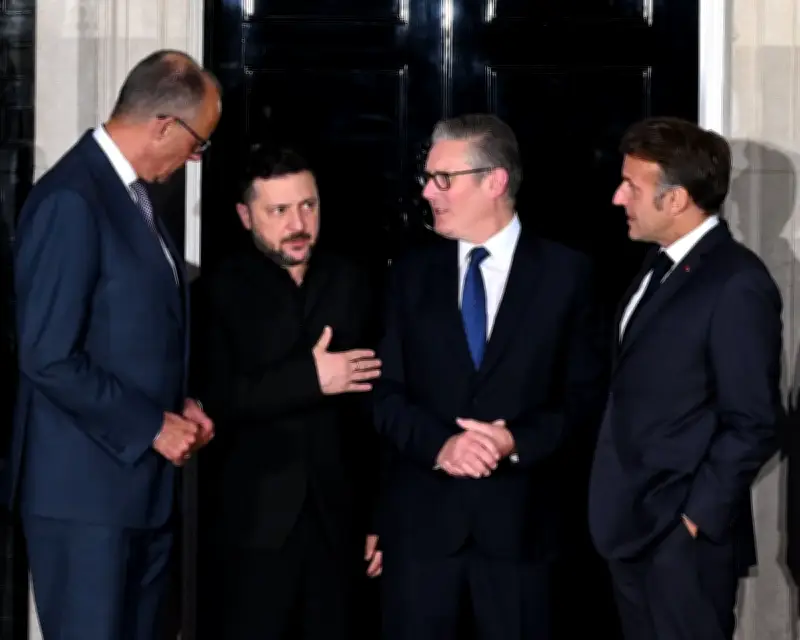
Volodymyr Zelenskyy and the leaders of the UK, France, and Germany discussed "the urgent need to scale up" Ukraine's air defences and deep-strike capabilities in London on Sunday night, after Russia fired hypersonic weapons at Ukraine, Downing Street said.
Meeting in Downing Street
The meeting of Ukraine's staunchest allies in London came hours after a Russian drone strike damaged a storage centre for spent nuclear fuel nine miles from the Chornobyl nuclear power plant. Keir Starmer welcomed Zelenskyy, Emmanuel Macron, and Friedrich Merz for a meeting to discuss ongoing support for Ukraine as the country seeks to capitalise on a series of strikes on key Russian positions.
A government spokesperson said the leaders discussed "the urgent need to scale up the production of interceptors and co-develop anti-ballistic missile and deep strike capabilities" after Russia fired Oreshnik weapons at Ukraine.

Condemnation and Ceasefire Call
The leaders condemned Russia's large-scale missile and drone attacks and called on the Russian president, Vladimir Putin, to agree "an immediate and complete ceasefire" with the current line of contact as a starting point for negotiations, Downing Street said. Leaders will now look to the G7 summit at Evian on 15 June to drum up more support for Ukraine and push for further economic sanctions and "an increased pledge of military and defence support for Ukraine at the Nato summit" in July.
Starmer and the Ukrainian president continued talks for about half an hour after the departure of Macron and Merz, before shaking hands and briefly posing for photographs outside No 10 on Sunday evening. The leaders of the so-called E3 group of nations – the UK, France, and Germany – gathered after a week of heightened hostilities and after Putin rejected Zelenskyy's proposal of face-to-face talks on Moscow's war. The UK and France are leading a "coalition of the willing" initiative to provide security guarantees for Ukraine.
Zelenskyy's Vow and Talks
Before the meeting, Zelenskyy vowed that Ukraine would not "silently die." He told Sky News: "We will respond. We will be stronger and stronger each day." He said talks would focus on support for Ukraine and cooperation on air defence "for the security of all of Europe." Zelenskyy, who will meet King Charles on Monday, thanked the UK and Ukraine's other allies, who he said in a social media post were "helping us strengthen the protection of life and increase pressure on Russia for its aggression."
The meeting followed a series of devastating Ukrainian strikes on targets inside Russia, including Vladimir Putin's home city of St Petersburg. Long-range Ukrainian drones hit an oil terminal and a nearby naval port this week, sending black smoke billowing into the sky. The attacks began hours before the start of the city's international economic forum. Speaking at the event on Friday, Putin rejected an offer made in an open letter by Zelenskyy to hold face-to-face talks. He said his war goals were unchanged and there was "no point" in holding peace negotiations. Zelenskyy described Putin's response as "weak." He said Ukraine's deep strikes would continue against targets in Russia.
Optimism in Kyiv
The mood in Kyiv is increasingly optimistic. On the battlefield, Russia's advance appears to have stalled. Ukraine claims Moscow is losing more men than it can recruit, with more than 30,000 killed and injured a month. Russia's air defences are seemingly unable to shoot down Ukrainian drones capable of flying more than 620 miles from the frontline. On Saturday, Ukraine struck St Petersburg again, reportedly targeting an ammunition dump and oil terminal in nearby Kronstadt. The city's governor said three people sustained minor injuries.
Ukraine's special operations forces released footage of overnight strikes on fuel storage facilities in occupied Crimea. The attacks took place in the towns of Lenine and Feodosia. Drones also knocked out a bridge connecting the peninsula with the Chonhar crossing point, a gateway into Russian-controlled southern Ukraine. The attacks have led to severe fuel shortages in Crimea, with the crisis beginning to spread to other areas including southern Russia.

Chornobyl Attack
Zelenskyy called Sunday's attack on a storage facility near Chornobyl "extremely vile" and stressed that it did not lead to a spike in radiation. A fire in the building was quickly extinguished. Large amounts of nuclear fuel were stored a few metres away, the International Atomic Energy Agency said. "An extremely critical infrastructure facility – and an extremely vile Russian strike," Zelenskyy wrote on X, adding that Russia had used an Iranian-designed Shahed attack drone. "As of now, there are no readings exceeding normal background radiation levels. But there is certainly an increase in Russia's brazenness, which long ago went off the charts."
Four people were killed by Russian aerial bombs. They included two people waiting at a bus stop in the village of Balabyne, in the southern Zaporizhzhia region, and a 56-year-old minibus driver whose vehicle was targeted nearby. An attack in the neighbouring Dnipropetrovsk oblast killed a 59-year-old man, the region's governor posted on Telegram.