The Reserve Bank rejected its own staff’s requests for a real pay rise and backpay on lost wages just hours after it hiked interest rates on Tuesday.
While the RBA has repeatedly warned that inflation-matched wage growth risks pushing up consumer prices, its employees argue the bank’s own forecasts show their pay will slip behind the cost of living.
Governor concedes wage cuts
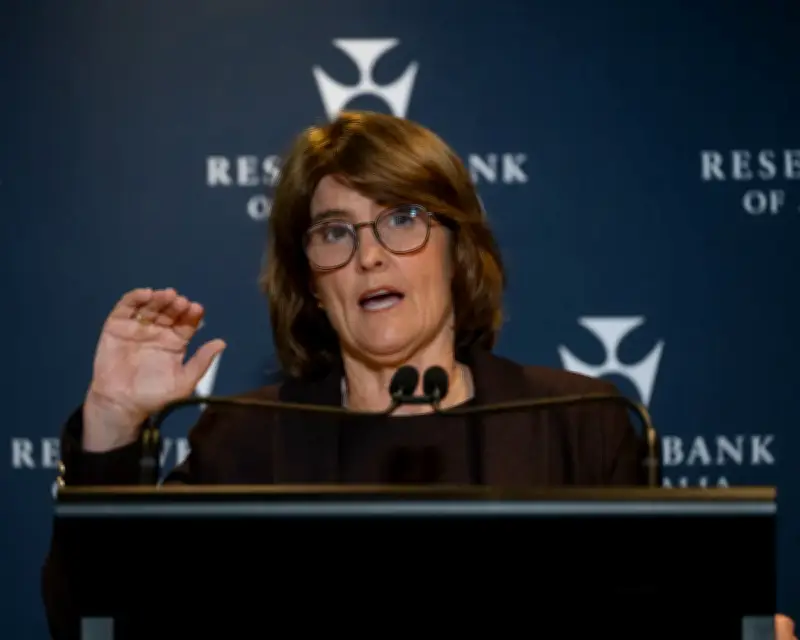
Announcing the rate hike at the RBA’s Sydney headquarters, the governor, Michele Bullock, conceded Australian workers were suffering real wage cuts.
“People are feeling, quite rightly, very annoyed and very upset about the fact that the costs of everything are rising, that their wages are not keeping pace with that [inflation],” Bullock said.
As staff left the office on Tuesday evening, Bullock emailed them asking them to vote for a pay offer nearly identical to one already rejected by 54% of staff in July.
Pay offer and union response
The RBA has offered a 9.5% pay rise over three years, split between 3.7% in the current year, then 3% and 2.8% in subsequent years. The defeated July offer proposed a 3.5%, 3% and 3% split.
Prices across the economy rose 4% in the year to August, above RBA forecasts.
“Some of you have told us about the pressure of higher living costs,” Bullock’s email to staff read. “At the same time, we need to balance that with our responsibilities as Australia’s central bank.”
Staff have requested increases of 11% over three years or in line with inflation, whichever is higher. They have also sought work-from-home protections and backpay for the current pay period, which started in September.
The RBA has rejected each of these and could not reach agreement with the Finance Sector Union (FSU), representing staff, at the Fair Work Commission on Tuesday.
Pressure on staff
Staff are already hundreds of dollars out of pocket and could miss out on months of higher pay if they do not give in and accept the RBA’s offer, a point underlined in Bullock’s email.
“If the next vote returns a yes result … the increase could be reflected in our pay a month or more earlier,” it read.
The email suggested staff may not receive a pay rise this calendar year if the offer was not supported.
Bullock has warned that labour costs across the economy are rising by 3.5% and adding to inflation, most recently at a parliamentary hearing in September.
“That’s got inflationary pressure baked into it, and while that is the case we’re going to have to be concerned about bringing inflation down,” Bullock told the hearing.
“We won’t be comfortable while unit labour costs are rising by more than – our target was 2.5%.”
Staff concerns and costs
Staff, not authorised to speak publicly, said the bank seemed more concerned about public perceptions than the cost of a wage rise. The RBA declined to comment.
One employee said colleagues were losing trust in senior management and viewed the backpay refusal as an effort to pressure staff into accepting the deal.
“Everyone seems to be really fired up now [by] the fact the second offer was basically worse than the first,” one staff member said.
“I’ve never heard anyone speak ill of upper management … [but] people have become pretty incensed and that has the potential to really undermine the work that gets done.”
The union has said the revised offer is unacceptable and warned RBA staff will probably quit and seek work elsewhere.
“The RBA should be a model employer, but instead they are treating their staff like mugs,” Julia Angrisano, the FSU national secretary, said on Friday.
The RBA has faced surging staff costs after its headcount rose from about 1,400 employees in 2021 to 2,000 in 2025, with a combined annual cost of $394.9m as of June 2025.
It is also spending an extra $1bn to renovate its historic office in Sydney’s Martin Place after asbestos was discovered and construction costs surged. Bullock in 2025 said she had low confidence in the revised cost, originally forecast at $260m.
A vote on the pay offer is expected from 15 to 19 October, days after the federal public service pay decision is announced. Public servants are seeking a pay rise of 15% over three years, which the Albanese government has claimed is impossible.