
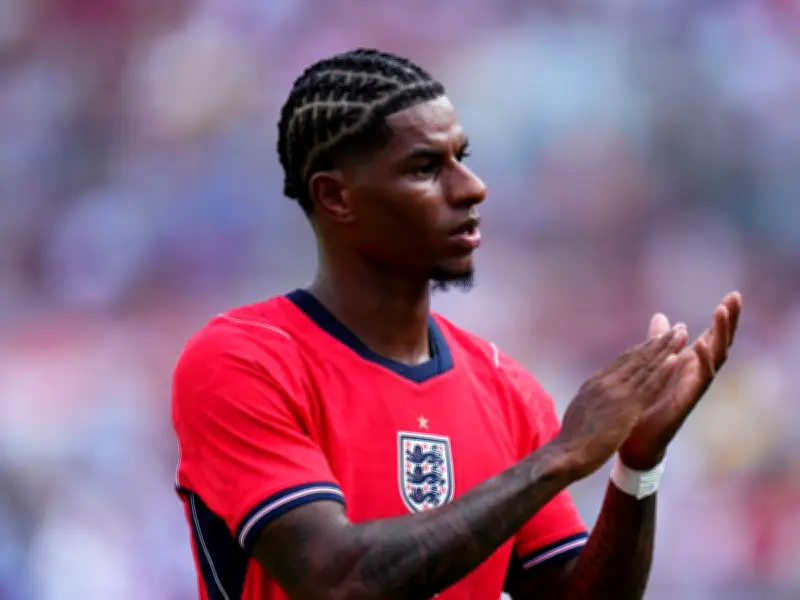
From the time he scored twice on his senior debut in a 5-1 win over FC Midtjylland, Marcus Rashford has always been a game-changer. And always will be. He has game-changing pace, a game-changing strike - with both feet - and game-changing talent. That is indisputable. How often he engages that game-changing gear is another matter.
Which is why, as he prepares for what could be a key role in England’s World Cup campaign, he finds himself in slightly bizarre limbo. Rashford is 28 and has never looked fitter. He is in his prime. Yet Barcelona have decided not to take up a £26million option to buy the Manchester United attacker. Even if Barcelona believe they can get another loan deal, it is hard to fathom.
Allowing for reservations about his application - triggered by the odd disciplinary concern - £26million seems a relatively trivial amount for a game-changer. In fact, the £40million that a Premier League club will have to pay if they want to try and sign Rashford looks like very good value. The word from Rashford’s camp is that he does not want to play for another Premier League club. Which only makes his situation all the more complicated.
And oddly, FIFPRO, the global players’ union, has a role to play. Recently, FIFPRO signed a memorandum of understanding with FIFA that says if a player is ostracised from a club’s main training group, he can demand to have his contract paid up, be given compensation, and be released. No more bomb squads. If Rashford, whose United contract expires in the summer of 2028, does not go to another club, he cannot be frozen out by Michael Carrick. But let’s imagine Rashford showcasing his talent on the grandest stage over this next month. It is not too hard to do.
Michael Carrick has always been a fan of Marcus Rashford's but won't have the final say on the player's future. Why would United not want to reintegrate him and make him part of what is already shaping up to be an exciting new era? The answer is in the question. He is part of the old era. An era when players undermined the managers. An era when players' enthusiasm for the task was questioned. That was not specific to Rashford or any one player - just a general feeling.
Rashford has a contract that gives him £325,000 a week. That simply does not fit in with the financial structure being implemented by part-owner Jim Ratcliffe. Matheus Cunha earns around £200,000 a week and has worn Rashford’s number ten shirt with some distinction already. Bryan Mbeumo and Benjamin Sesko earn slightly less than Cunha. And these are players who have been integral to the team’s revival under Carrick.
Rashford and Carrick have played together and worked together previously. Carrick is always complimentary about Rashford. I have always imagined a great player could have a fresh start at his boyhood club. But the more you hear from the United camp, the less likely that seems. Because in the end, it will not be Carrick’s decision. And even though it was Ruben Amorim who wanted Rashford out, it was a stance fully endorsed - and acted on - by Director of Football, Jason Wilcox. A U-turn from Wilcox, and chief executive Omar Berrada, is extremely unlikely.
Which is why, however he performs at the World Cup, Rashford’s club future is in this bizarre limbo. And which is why the chances of him being seen in a United shirt again appear to be slim to none.




