

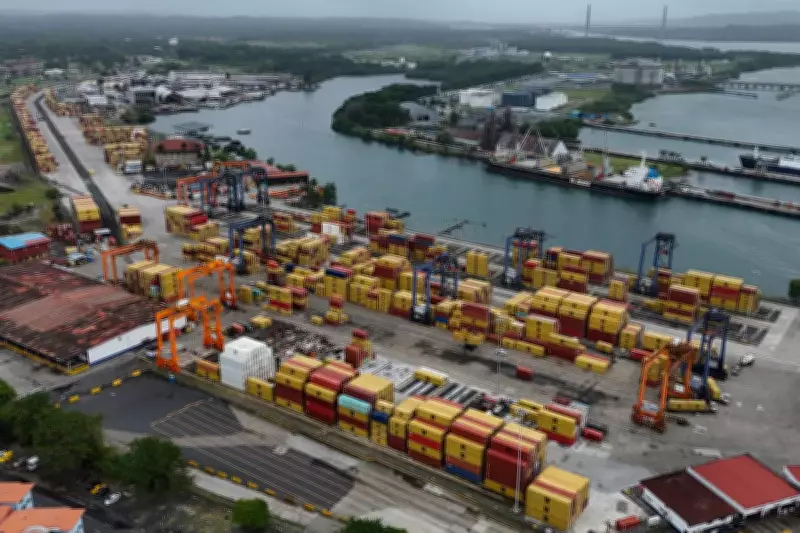
Hong Kong's CK Hutchison Holdings has issued a stark warning of potential legal action against Danish logistics and ports group A.P. Moller-Maersk, as tensions escalate over the operation of two vital ports at both ends of the Panama Canal. The confrontation follows a ruling by Panama's Supreme Court in late January that declared the concession held by a CK Hutchison subsidiary to operate these ports unconstitutional.
Panamanian Court Ruling Sparks International Dispute
Panamanian authorities have announced that a subsidiary of Denmark-based A.P. Moller-Maersk will temporarily take over the operation of the two ports during a transitional phase. This interim arrangement is intended to persist until a new concession can be competitively bid and formally awarded. The Hong Kong conglomerate, however, has vehemently opposed this development, asserting its rights under longstanding agreements.
Geopolitical Rivalry Intensifies Port Saga
The dispute over the Panama Canal ports is deeply entangled within the broader strategic rivalry between the United States and China, with Panama finding itself caught in the crossfire. Last year, former U.S. President Donald Trump publicly alleged that China was effectively "running the Panama Canal," a statement that heightened scrutiny over CK Hutchison's operations. Subsequently, the Hong Kong company was expected to sell the two ports to a consortium that included U.S. investment firm BlackRock.

Beijing's swift intervention, however, stalled that prospective deal, illustrating the complex geopolitical dimensions at play. The January ruling by Panama's Supreme Court has now introduced further uncertainties into CK Hutchison's strategic plans for divesting the ports, complicating an already fraught situation.
CK Hutchison's Legal and Diplomatic Offensive
Last week, CK Hutchison publicly stated its strong disagreement with the Supreme Court's decision and revealed it had initiated arbitration proceedings against Panama. On Thursday, the company escalated its response, issuing a formal statement outlining additional measures to protect its interests.
The company explicitly notified A.P. Moller-Maersk that any attempts by the Danish group or its subsidiary to operate the two ports without CK Hutchison's consent would likely trigger legal recourse. This direct warning underscores the high stakes involved in the operational control of these critical maritime assets.
Uncertainty Over Port Operations Continues
Despite assurances from Panamanian President José Raúl Mulino that port operations would continue uninterrupted following the court's decision, CK Hutchison expressed skepticism. The company emphasized that the continued smooth operation of the ports now depends entirely on the actions of the Panama Supreme Court and the Panamanian State, factors beyond its direct control.
In a significant move, CK Hutchison also notified Panama of a formal dispute "pursuant to an investment protection treaty," a mechanism designed to safeguard its rights and interests at the ports. This action is in addition to the arbitration procedure already underway, indicating a multi-pronged legal strategy.
Historical Context and Longstanding Operation
Panama Ports Co., a subsidiary of CK Hutchison, has been operating the two pivotal ports since 1997. Its concession was renewed in 2021 for an additional 25-year term, a fact that the company cites in defending its legal position. The Panama Canal itself, a crucial global trade passage linking the Atlantic and Pacific Oceans, was constructed by the United States in the early 20th century.
Washington operated the canal for decades before transferring full control to Panama in 1999, a historical backdrop that adds layers of national and international significance to the current commercial dispute.
CK Hutchison concluded its statement by affirming its commitment to explore all available recourse, including potential additional national and international legal proceedings. The situation remains fluid, with the outcome likely to have significant implications for global trade logistics and international investment law.






