
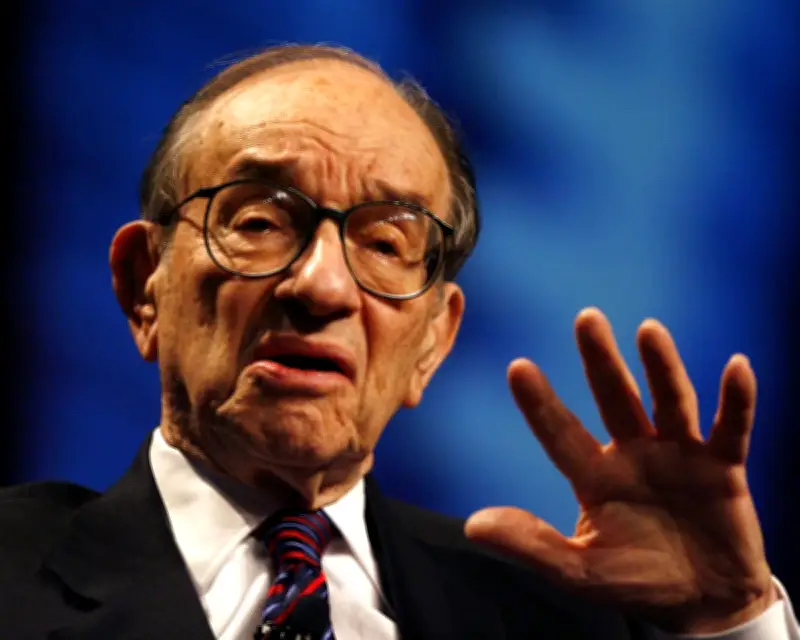
Alan Greenspan, the American economist who chaired the US Federal Reserve from 1987 to 2006 and was once hailed as the Maestro for overseeing the longest economic boom in US history, has died at the age of 100. His reputation, however, was significantly tarnished after the 2008 financial crash, which occurred on his watch.
Early Life and Career
Born in New York on March 6, 1926, Greenspan was raised during the Great Depression. His parents divorced shortly after his birth, and he lived with his mother and grandparents in a cramped home in Washington Heights. He began his adult life playing the saxophone and clarinet in a New York swing band, the Henry Jerome orchestra, before studying economics at New York University, where he earned a BA in 1948 and an MA in 1950. He later received a PhD from NYU in 1977.
Rise to the Federal Reserve
Before entering public life, Greenspan was a partner in Townsend-Greenspan, a successful economic forecasting firm. He advised Richard Nixon on his 1968 presidential campaign and served as chair of the Council of Economic Advisers under President Gerald Ford from 1974 to 1977. President Ronald Reagan appointed him chairman of the Federal Reserve in 1987.
Key Interventions and Reputation
Within two months of taking office, Greenspan faced the Black Monday stock market crash on October 19, 1987, when the Dow Jones Industrial Average fell 22.6% in a single day. The Fed issued a statement pledging to provide liquidity, which helped calm markets. He also played a role in averting a global meltdown during the 1997 Asian financial crisis and restored confidence after the September 11, 2001 attacks.
His biggest triumph was presiding over the economic boom from 1991 to 2001. According to journalist Justin Martin in his 2000 biography Greenspan: The Man Behind Money, 'By the dawn of the new millennium, it was nearly impossible to find anyone in America who was not gaga over Greenspan. Democrats and Republicans, Wall Street and Main Street, dogs and cats – all were high on the Fed chairman.'
Criticism After the 2008 Crash
Greenspan's reputation suffered after the 2008 financial crisis, the worst since the Great Depression. Robert Reich, labor secretary under President Bill Clinton, wrote in the Guardian in 2009: 'There's no single culprit for the mess we're in, but Alan Greenspan comes closest.' A congressional commission investigating the crash concluded that Greenspan had championed deregulation for over 30 years, which 'stripped away key safeguards.'
In 2008, Greenspan admitted he was 'partially' wrong about his hands-off approach, acknowledging 'a flaw' in the libertarian ideology that guided him. He said, 'I made a mistake in presuming that the self-interests of organisations, specifically banks and others, were such that they were best capable of protecting their own shareholders.'
Influence of Ayn Rand
Greenspan was deeply influenced by Ayn Rand, the Russian émigré writer and philosopher. He met her in 1952 and became part of her inner circle for 15 years. He described her views as 'intoxicating,' and she called him 'my disciple philosophically.' Rand opposed government intervention in the financial sector, arguing that capitalism worked best when people acted out of rational self-interest.
Relationships with Presidents
Greenspan served under four presidents: Ronald Reagan, George H.W. Bush, Bill Clinton, and George W. Bush. His relationship with George H.W. Bush was strained; Bush blamed Greenspan for his 1992 re-election defeat due to the Fed's reluctance to cut rates. With Clinton, a Democrat, Greenspan established a rapport, and Clinton embraced deregulation and deficit cuts. Greenspan described Clinton as his favorite president, along with Ford. His relationship with George W. Bush was poor, particularly over responses to the dotcom bust and 9/11.
Later Life and Legacy
After leaving the Fed, Greenspan served as an unpaid adviser to the British Treasury and received an honorary knighthood from Queen Elizabeth II in 2002. He wrote several books, including The Age of Turbulence (2007), The Map and the Territory (2013), and Capitalism in America (2018) with Adrian Wooldridge. He criticized President Donald Trump's proposed tariffs in 2018, calling them 'insane.'
Greenspan married Joan Mitchell in 1952, but the marriage was annulled a year later. In 1997, he married television journalist Andrea Mitchell, who survives him.




