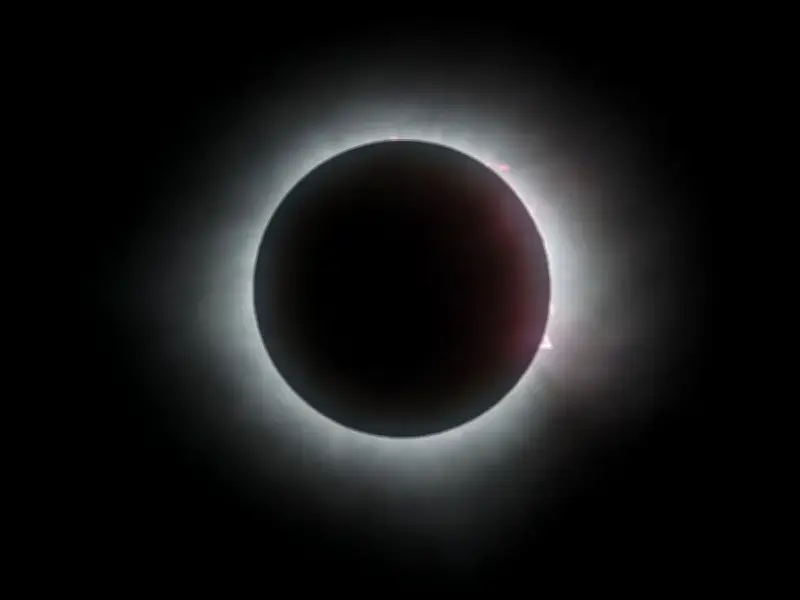
Sky watchers across parts of the world will be treated to a rare total solar eclipse this evening as the Moon passes between the Sun and Earth. Here in the UK, we're set to see our best partial solar eclipse in 27 years, with more than 90 per cent of the Sun's disk covered.
The spectacular event will begin shortly after 6pm on Wednesday (August 12), with maximum coverage expected around 7.12pm, but this may vary depending on where you are in the UK. As this happens and the country falls into the Moon's shadow, the sky is expected to dim as sunlight is blocked.
What to Expect from the Eclipse
Despite nearly 96 per cent of the Sun being covered by the Moon during the 2026 solar eclipse, the spectacle won't be as dramatic as a total solar eclipse, in which 100 per cent of the Sun is blocked by the Moon. Astronomers say total solar eclipses are seen every 400 years from any one place on the surface of the Earth - so has there ever been one in the UK?
Last Total Solar Eclipse in the UK
The last total solar eclipse in the UK was August 11, 1999. It was the first total eclipse visible from Europe since 1990, and the first visible in the UK since 1927. The dramatic eclipse could be seen from parts of the South West, in Cornwall and parts of Devon. For many areas, though, cloud cover obscured the view.
Next Total Solar Eclipse in the UK
After this week's deep partial solar eclipse, the next partial eclipse with a similar amount of coverage won't occur until 2081. And the wait is even longer for a total solar eclipse, which won't be visible from the UK until September 23, 2090.
How to Safely Watch the Solar Eclipse
Those hoping to view the solar eclipse are urged to not look directly at the Sun or view the eclipse through telescopes and binoculars unless they have a special solar filter. RAS President Professor Jim Wild said: "I would encourage everyone to enjoy the spectacle safely. Never look directly at the Sun without appropriate solar viewing equipment. Certified eclipse glasses, specially designed solar filters for telescopes and binoculars, or indirect methods such as pinhole projectors are all safe ways to observe the event. With the right precautions, this eclipse promises to be an inspiring experience for seasoned astronomers and first-time skywatchers alike."
And that's not all for Wednesday night. The peak of the Perseid meteor shower - one of the most spectacular of the year - falls overnight on August 12-13. It's best viewed a few hours after the eclipse - between midnight and 5.30am - according to Royal Museums Greenwich, with up to 150 meteors an hour lighting up the sky.