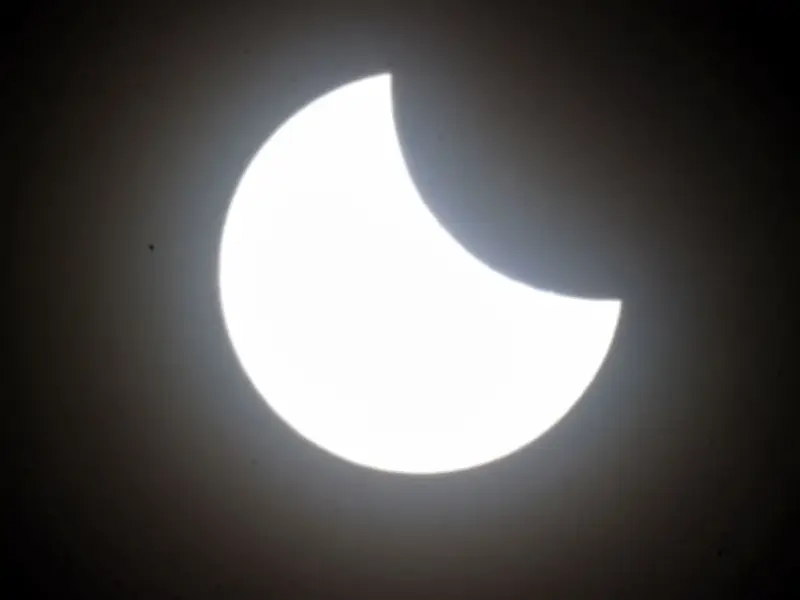
A solar eclipse on Wednesday evening will obscure up to 96% of the sun in parts of the UK, the fullest such event for 54 years. The next time the moon obscures as much of the sun will be in 2081.
Timing and best viewing spots
The eclipse will take place between 6.17pm and 8.06pm on Wednesday, August 12. Devon, Cornwall and parts of Pembrokeshire in Wales will see the eclipse at its fullest, with a range of 94% to 96% of the sun being blocked.
According to the Met Office, Plymouth will see the fullest eclipse, with the moon covering 94.66% of the sun at 7.16pm. The rest of Wales, Northern Ireland, parts of the West Midlands and the South West, and the westernmost parts of Scotland can expect to see 92% to 94% coverage.
Coverage across the UK
Birmingham will see 91.79% coverage, London 91.41%, Inverness 90.74%, Edinburgh 90.71%, and Newcastle 90.22%. Norfolk, Yorkshire and Aberdeenshire, as well as the Orkney and Shetland Islands, will see only 88% to 90% of solar coverage.
With the eclipse occurring late in the evening, the sun will be low on the horizon, so a clear view of the west is needed. Wednesday is expected to be another hot, sunny and clear day, with some scattered cloud across north and central areas in the evening.
Weather and safety advice
Meteorologists said Northern Ireland, Scotland and western parts of England have a “slightly lower” chance of seeing the eclipse, with southern and eastern parts of England the best places to view it.
Imo Bell, planetarium astronomer at the observatory, said: “It’s not a total eclipse, but over 90% is really exciting. We’re not going to get one this good for a really long time.
“So it’s important not to miss it, and to be prepared. You can’t just go out and expect to have a look because it’s really dangerous for your eyes.
“So you can use solar eclipse glasses, which are very, very different from sunglasses – they block out so much light that you can’t see anything through them except the Sun, because that’s how much light they need to block for the damaging light of the Sun to be safe to view.
“Ideally a solar telescope is an amazing way to witness it, and if you don’t have one of them then you can look into whether your local astronomy society is doing any events.
“And if all else fails, you can project the image of the eclipse using a household item like a colander which has lots of holes in – point the colander towards the Sun with your back facing it, and in the shadow of the colander you’ll be able to see the eclipse in the holes, which is really cool.”
Future eclipses
The next time the moon obscures as much of the sun will be in 2081, and the next total solar eclipse in the UK will be in 2090. The last total solar eclipse to take place in the UK was in 1999. There have been a number of partial eclipses since then, but this will be the most the moon has obscured the sun in 27 years.