The UK is bracing for a blistering 38C heatwave, with a 15-hour amber warning issued by the Met Office covering all of England from 9am Thursday until midnight. The warning says the "wider population is likely to experience some adverse health effects."
Separately, the UK Health Security Agency (UKHSA) has activated amber heat health alerts for much of England, running until Friday, warning of a "rise in deaths." The Government has urged people to drink plenty of water, check on vulnerable friends and family, and avoid the sun at the hottest part of the day.
Hottest summer on record
The scorching weather puts the UK on course for its hottest summer on record. The mean average temperature stands at 16.48C between June 1 and August 10, which is 1.88C above the 1991-2020 average.
Met Office senior scientist Mike Kendon said: "Another record-breaking summer now looks increasingly likely for the UK, following the second-warmest June, and second-warmest July on record and yet another heatwave imminent."
Pointing to repeated occasions in which the UK experienced temperatures of 35C or more, Kendon added: "These statistics are a clear reminder - if one were needed - of the stark changes that we are seeing in the UK's climate."
Drought and wildfires
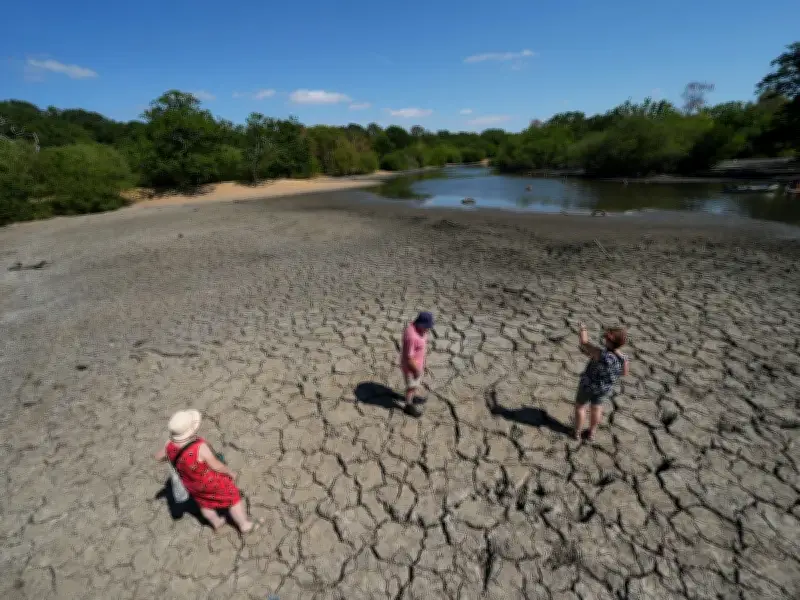
The record-breaking heatwave - the fifth of the year - has caused chaos across the UK, sparking raging wildfires, creating problems for farmers and driving rivers to record lows. The heat was so severe it exposed the remains of a lost village that was demolished and flooded to create a reservoir.
Stonework and the outlines of buildings in Nether Hambleton were seen today because of the low water levels at Rutland Water reservoir in the east Midlands. More than 3,000 acres of land were submerged in the 1970s to create what was then Europe's largest man-made lake, with residents rehoused in the surrounding areas. Among the lost buildings were 18th century homes and farmland growing barley to be sold to Germany for brewing lager and wheat which Hovis bought for breadmaking.
Temperatures today are thought to have topped 26C in London, 28C in Manchester and 28C in Cardiff, before the mercury is expected to soar in some areas to 34C tomorrow and 38C on Thursday. Meteorologists believe showers could move across the country on Sunday - bringing the first spattering of rain to southern areas in two months.
Almost three quarters of England - affecting 45 million people - have experienced "flash droughts," with 27 million people slapped with hosepipe bans. In Wales almost the entirety of the country was in drought, with hosepipe bans imposed by Wales Water for more than 33,000 people.
Health and safety advice
Met Office chief forecaster Chris Bulmer said: "While the peak heat will be more short-lived than recent heatwaves, temperatures widely into the mid-30Cs on Thursday bring the potential for impacts for some, which is why a Met Office warning has been issued."
Met Office Deputy Chief Forecaster David Oliver said: "While Thursday will be the peak of the heat this week, some warmth will remain in the south and south east on Friday, before easing more widely on Saturday as cooler air spreads south from the north west."
Farmers are struggling to cope with the intense heat, with experts warning it would drive up food and drink prices. The Food and Drink Federation (FDF) said "fruit, vegetable and grain supply" are being hit, with crop shortages set to feed into supermarket prices.
Firefighters continued to battle a series of fires across the UK, including one in the New Forest National Park, Hampshire. Emergency crews began a third day of tackling the blaze - that at one point covered an area equivalent to 140 football pitches - as they say they are "managing to contain" after working "tirelessly" through the night.
The National Fire Chiefs Council said July was the busiest month on record for wildfires, with services responding to 966 wildfires this year, just shy of the 1,017 they attended during a record-breaking year in 2025. In July alone, firefighters attended 458 wildfires, whilst in the first 10 days of August crews have been called out to 185 wildfires.
Phil Garrigan, chairman of the council, said: "The combination of drought conditions and another heatwave means the risk of fires remains high, and these incidents can place huge demands on firefighters and specialist resources. Many wildfires are preventable so we're asking people to be vigilant and take extra care outdoors while these conditions continue."
The Fire Brigades Union said its members were under increased pressure as a result of an "unprecedented summer of dangerous and volatile wildfires." Steve Wright, the FBU general secretary, said the unpredictable environmental challenges the UK was now confronted with meant it was a "national priority" to have enough properly equipped firefighters to "face these threats."
He called for "increased funding, improved access to the best equipment and better national resilience" to combat rising demands. He said: "Our country is facing unpredictable environmental challenges and it must be a national priority to ensure we have enough properly equipped firefighters to face these threats."
William Spencer, climate and first aid expert at the British Red Cross, said: "While periods of hot weather have become more familiar in recent years, they can still pose serious risks to health. In fact, after prolonged dry and warm conditions, it is more important than ever to follow heat safety advice."
Caroline Abrahams, Age UK's charity director, said that as people age, their bodies find it harder to adapt to extremes of heat and cold. She said: "Even younger and otherwise healthy people can feel the effects of very hot weather, but with temperatures forecast to reach up to 36C in some areas, the risks can be much greater for older people."