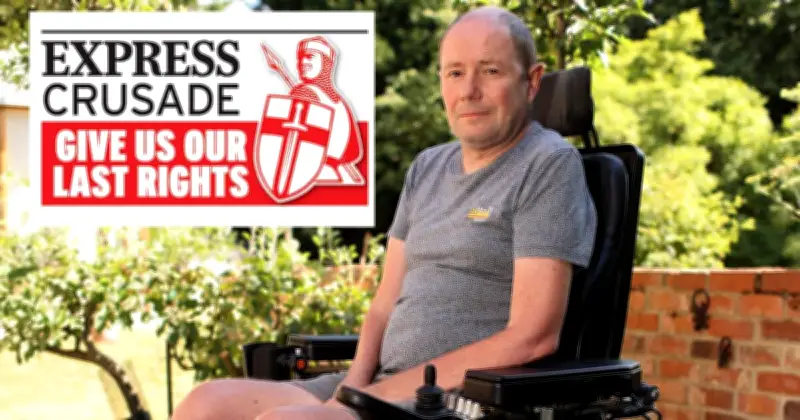
Phil Newby, a terminally ill father with motor neurone disease, has invited the Prime Minister to meet him for a discussion on assisted dying while he is still able to speak. Newby, who was diagnosed 12 years ago and is slowly becoming paralysed, has campaigned for assisted dying for seven years, taking his case to the High Court and Court of Appeal.
A Personal Invitation to the PM
Newby hopes Mr Burnham will agree to a “rational, sensible discussion by two people who happen to be 56 years old.” He added: “One is poorly, the other has a great deal of potential power to solve something really important. We both have kids of a similar age.”
“I hope he will understand my life position, and probably what is to come, and that I can see the opportunity available for him,” Newby said. The Express is urging the Prime Minister to meet with Phil before September 11, the date of the next crucial Commons debate on assisted dying. If MPs back the Terminally Ill Adults (End of Life) Bill for a second time, the House of Lords will not be able to block it again.

Concerns Over Palliative Care Comments
Mr Burnham recently sparked concern among campaigners when he suggested that palliative and social care should be fixed before any debate about assisted dying takes place. His comments did not acknowledge the dozens of days Parliament has already spent considering this issue, or the urgent plight of many terminally ill people who want the option to die with dignity.
Phil believes that improving palliative care and legalising assisted dying should happen in parallel. He said: “I think that if the Prime Minister, through his health minister and junior minister, actually develops a really good, funded plan for palliative care, that would move a lot of the wavering MPs.”
Phil's Letter to the PM
Phil's letter adds: "Thinking about palliative care and assisted dying together hits the nail on the head. Both urgently need fixing and neither are good enough without the other. What we all need is a PM with the political courage and the ambition to do it. Not as a perhaps and maybe, but as a single plan to be delivered within five years. We fought and won a world war in less time."
Phil lives in Rutland, East Midlands, with his wife Charlotte. He was diagnosed with MND in May 2014 after suffering from muscle cramps. He was bluntly told that patients typically live for two to three years and he should begin preparing for the end of his life. Phil has outlived that prognosis, giving him the opportunity to see his daughters — Sasha, 23, and Jess, 21 — grow up.
Living with the Disease
But he is now increasingly short of breath, reliant on a ventilator every afternoon, evening and night, and battling multiple health problems. Phil said: “I talk less well. I breathe less well. I have less ability to function. I have more problems, so there are always too many fires to put out. One thing climbs on top of another — all the results of a really horrendous, unpleasant disease.”
During the years since his diagnosis, Phil has contemplated how he might hasten his death if his suffering becomes too much to bear. But his escalating loss of function means it would be almost impossible for him to take his own life without assistance. As his symptoms progressed in early 2020, Phil launched a High Court case requesting a judicial review of the law against assisted dying. The case went to the Court of Appeal but was dismissed after 18 months.
He has continued campaigning in the years since, producing a 10-episode podcast where he discussed aspects of the debate with guests including former Lib Dem leader Sir Vince Cable and a leading disability rights activist from Not Dead Yet, a group strongly opposed to assisted dying. Phil has argued in favour of disabled and terminally ill people’s voices being put at the heart of the debate, which he fears is too often dominated by vocal campaigners with polarised views.

Reactions and Next Steps
Having kept track of the Bill’s progress, he added: “I think Kim Leadbeater was incredibly courageous, and the people who want to bring down this bill did every single thing in their power to disrupt, distort and damage the Bill, to torpedo it to nibble away support for it. It's a bit like a criminal trial when you have to prove everything beyond reasonable doubt. The other side picks away, introducing half truths and distortion just to get to wavering MPs. I think what happened in the Lords was a kind of democratic disgrace.”
Davina Hehir, deputy chief executive of Dignity in Dying, urged the Prime Minister to make time for this important conversation. She said: “MPs have already voted twice to back a change in the law. On 11 September, they get the chance to finish what they started. This isn't abstract politics; around twenty people a day die with suffering that even the best palliative care can't reach, while others are forced to take matters into their own hands, at home or abroad, with no safeguards at all. I would urge the PM to meet Phil and other terminally ill or bereaved families, because fixing care, vital as that is, won't remove dying people's need for choice too.”