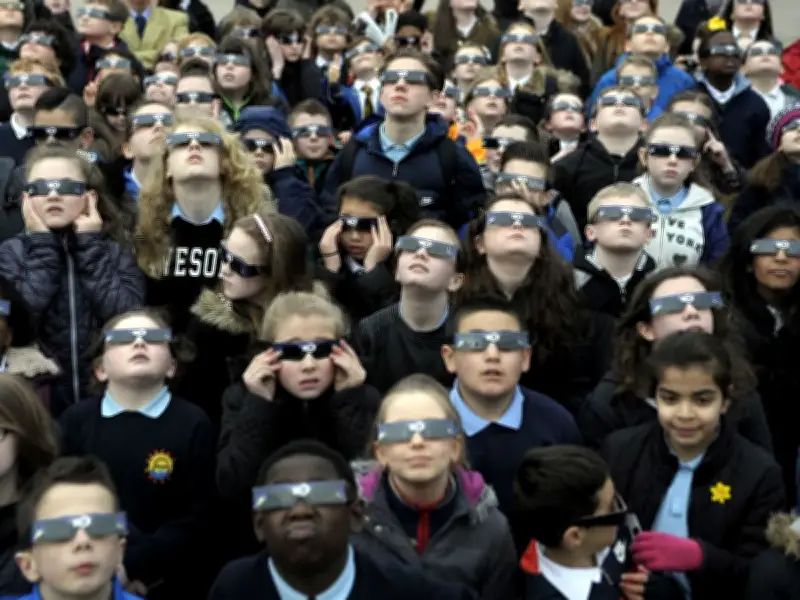
Scientists have issued a stark safety warning ahead of the solar eclipse on Wednesday, August 12, urging observers to prioritise safety. They warn that watching the eclipse without protection can lead to permanent eye damage, describing it as "sunburn" on your retina.
Rare event but risks are real
A partial solar eclipse is a rare astronomical event, with the last one taking place in Scotland over a decade ago. However, to enjoy the event properly, observers are urged to take safety measures such as acquiring specialised solar eclipse glasses or watching the eclipse through a pinhole projector.
Directly watching a solar eclipse can cause significant damage to your eyes, which could lead to a variety of complications. NHS24 warns: "While it may be tempting to take a good look at this rare natural phenomenon, viewing the sun without proper protection can cause permanent eye damage."
Experts echo 'don't do it'
Sharing further insight into sun-retina damage, Professor Hannah Fry and educator Michael Stevens have issued a "don't do it" warning ahead of the event. Uploading a clip from their The Rest Is Science podcast, Michael stated that the damage was similar to those who had watched an atomic bomb explode.
In the TikTok clip, Hannah said: "When we say safely, what we are talking about here is that I mean it is literally sunburn on the inside of your eye." Explaining the severity of the sun's intense rays, even from behind the moon, Michael added: "Your retina gets burned and it gets burned fast and usually permanently. I actually found some pictures of people's retinas that were damaged by looking at the most recent solar eclipse, and guess what... We won't show it because it is very gory but it's basically exactly the same as another picture I saw of a soldier's retina that was damaged because he watched an atomic bomb go off. So don't do it. Don't do it!"
Other specialists warn too
Other specialists have also warned observers to take measures to protect their eyesight during the solar eclipse this week. Ophthalmologist Chantal Cousineau-Krieger previously said: "Watching an eclipse can be fun, but never look directly at the sun. You can seriously damage the retina and even be permanently blinded."
The National Eye Institute (NEI) states that the reason eyes can become damaged by directly watching the solar eclipse is because the sun emits high levels of UV radiation, which damages the cells on the eye's surface and at the back of the eye. Direct exposure to intense sunlight can also cause thermal damage to the eye as the sun emits infrared radiation. This can lead to inflammation, discomfort and tissue damage.
Main risks of watching a solar eclipse
Solar Retinopathy is a condition caused by the sun's intense light and can result in permanent loss of vision. Symptoms include sensitivity to light, blurred vision, dark spots in your central vision, sensation of pressure in the eye or changes in colour perception. These symptoms may not appear immediately after sun exposure but instead gradually develop over hours or days. While some of these symptoms may resolve on their own, they could also persist or worsen in more severe cases.
Photokeratitis, otherwise known as 'welder's flash' or 'sunburned eyes', can occur as a result of exposure to intense UV rays from the sun. Symptoms may include redness, tearing, pain, and a feeling of sand in the eyes. While this condition is usually temporary, it can increase the risk of long-term eye damage if repeated episodes occur. This could develop into cataracts or abnormal tissue growth on the surface of the eye.
Macular Edema is a condition where prolonged sun exposure during an eclipse could lead to the central part of the retina swelling, which can lead to vision distortion and potential permanent damage. While symptoms may develop over time, it could lead to reduced contrast sensitivity, making it hard to distinguish between objects of a similar colour.
If you or someone you know experiences any of these symptoms, it is essential to seek advice from a doctor to prevent further damage.