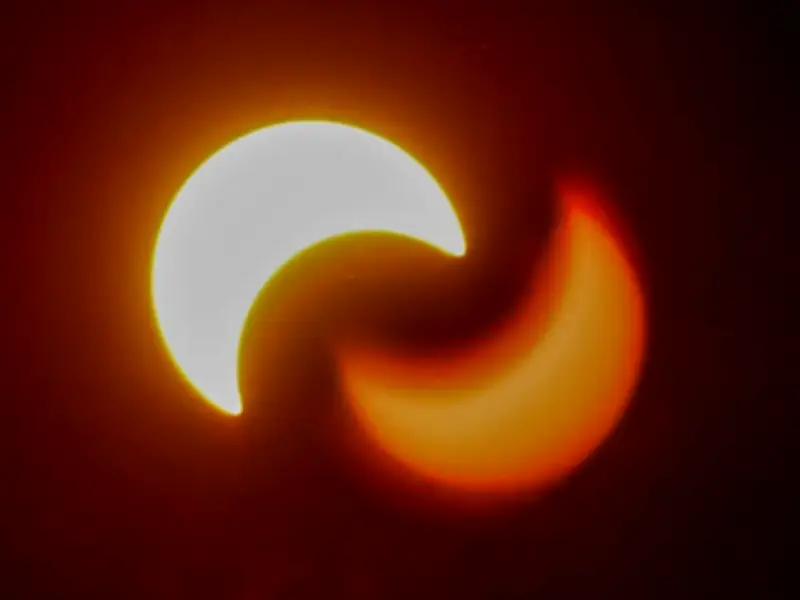
Solar eclipse glasses have completely sold out throughout the UK, and securing delivery from major online retailers by this evening appears virtually impossible. Nevertheless, those eager to safely witness the first near-total solar eclipse in the UK since 1999 still have several options available.
Timing and availability
The astronomical phenomenon is expected to commence at approximately 6pm today (August 12), reaching its maximum shortly after 7pm before concluding around 8pm. Precise timings will vary depending on your location across the country.
Specialist eyewear stocks have been depleted ahead of the event, with corner shops, national parks and the Royal Observatory Greenwich all running out. The observatory alone has shifted roughly 15,000 pairs over the past month.
Safety warnings
Experts have cautioned against being lured by "knock-off" alternatives or resorting to regular sunglasses. Eclipse glasses must comply with the ISO 12312-2 safety standard, as uncertified versions could potentially expose eyes to dangerous solar radiation.
Mohamed Elalfy, consultant ophthalmologist and president of the Royal College of Ophthalmologists, said: "The safest way to enjoy the eclipse is to observe it indirectly, such as by watching a live broadcast."
"Looking directly at the Sun during a solar eclipse can cause damage to the retina, potentially damaging the cells responsible for sharp central vision. Crucially, the retina has no pain receptors, so people will not feel the damage as it happens."
The risks were brought to the fore after the UK's 1999 total solar eclipse, with the Royal College of Ophthalmologists recording approximately 70 instances of individuals suffering vision issues after witnessing it. Remarkably, around 40% had gazed at the eclipse for under a minute, reports the Express.
It can take several hours for symptoms to manifest, which include "blurred vision, a central blind or dark spot, distorted vision, reduced colour perception and increased sensitivity to light". Mr Elalfy continued: "While some people recover over weeks or months, others can be left with permanent visual impairment."
Recent Specsavers research has revealed that 10% of Britons have previously observed a solar eclipse without protective eyewear, while 19% mistakenly thought it was safe to watch one through a camera or smartphone screen.
Safe viewing methods
One of the most straightforward alternatives requires nothing more than a kitchen colander. Instead of gazing towards the Sun, observers can utilise its holes to cast images of the eclipse onto the ground or another surface.
Imo Bell, a planetarium astronomer at the Royal Observatory, explained: "You can project the image of the eclipse using a household item like a colander which has lots of holes in - point the colander towards the Sun with your back facing it, and in the shadow of the colander you'll be able to see the eclipse in the holes, which is really cool."
An alternative method involves creating a pinhole projector from a single piece of card, while a more sophisticated version can be assembled using a cardboard box.
Trees themselves can also offer a means of witnessing the phenomenon. According to UK Health Security Agency guidance, spaces between foliage can cast images of the Sun in a similar manner to the perforations in a colander. Observers should position themselves with their backs to the tree and view the eclipse manifesting in the shadows formed through the gaps.
Using optical equipment
Kyla Black, Boots Opticians director of optical practice, said: "Budding astronomers who will be looking through cameras, binoculars or telescopes at the eclipse must make sure they have approved solar filters attached. If you're not sure your telescope does, then contact the maker of the product to ensure you know you'll be safe."
Local astronomy centres may also be hosting observation events using appropriately filtered telescopes, offering an additional option for those who have been unable to obtain eclipse glasses in time.