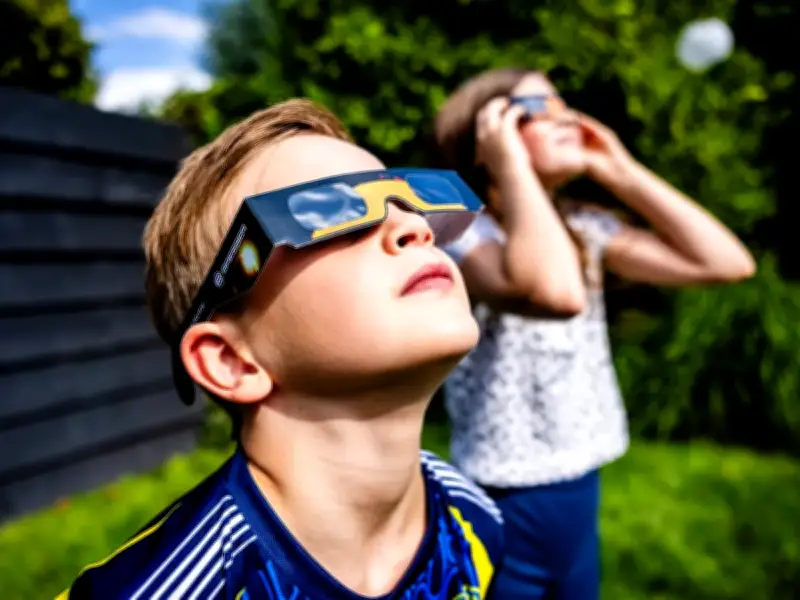
A warning has been issued to Brits hoping to catch a glimpse of the solar eclipse on Wednesday evening, as safety-approved glasses have sold out on Amazon if you want them on time.
Wednesday will bring the first near-total eclipse to the UK since 1999, and will be the last chance to see one until 2081. The event will start at around 6pm and end at around 8pm, peaking shortly after 7pm. The exact timings vary across different parts of the country.
Safety-approved solar eclipse glasses have been selling out online. Consumers have been warned against using “knock-off” glasses instead. Eye doctors have also urged people to avoid looking directly at the Sun, with even brief exposure causing lasting vision damage.
Safety Standards and Risks
Only special solar eclipse glasses that are ISO 12312-2 certified for the safest eye protection should be used, experts say. They have all but sold out or carry hefty delivery fees to arrive in time.
Experts say so-called eclipse glasses that do not carry the safety standards, or ordinary sunglasses, should never be used as they reduce glare, making it feel more comfortable to look at the Sun for longer, but still allow harmful solar radiation to reach the retina.
Following the 1999 total solar eclipse, the Royal College of Ophthalmologists reported around 70 cases of people experiencing vision problems after watching the eclipse. Around 40% had looked at it for less than a minute.
Expert Advice
Mohamed Elalfy, a consultant ophthalmologist and president of the Royal College of Ophthalmologists, said: "The safest way to enjoy the eclipse is to observe it indirectly, such as by watching a live broadcast."
"Looking directly at the Sun during a solar eclipse can cause damage to the retina, potentially damaging the cells responsible for sharp central vision. Crucially, the retina has no pain receptors, so people will not feel the damage as it happens."
"Symptoms may only become apparent several hours later and can include blurred vision, a central blind or dark spot, distorted vision, reduced colour perception and increased sensitivity to light. While some people recover over weeks or months, others can be left with permanent visual impairment."
How to Watch Without Glasses
Thankfully, there are some ways you can view the eclipse without using safety-approved glasses.
Use a colander. Imo Bell, a planetarium astronomer at the observatory, explains: "You can project the image of the eclipse using a household item like a colander which has lots of holes in – point the colander towards the Sun with your back facing it, and in the shadow of the colander you’ll be able to see the eclipse in the holes, which is really cool."
Use a pinhole projector. You can make a simple one with a single sheet of card or something more ambitious using a cardboard box.
Use trees and leaves. The UKHSA's official advice says you can also use gaps between tree leaves similarly to how you would use a colander to view the Sun's image. Just turn your back to the tree and you’ll be able to see the eclipse in the shadows coming between the gaps.
Use a telescope. Kyla Black, Boots Opticians director of optical practice, said: "Budding astronomers who will be looking through cameras, binoculars or telescopes at the eclipse must make sure they have approved solar filters attached. If you’re not sure your telescope does, then contact the maker of the product to ensure you know you’ll be safe." Local astronomy centres may also have viewing events that use telescopes.