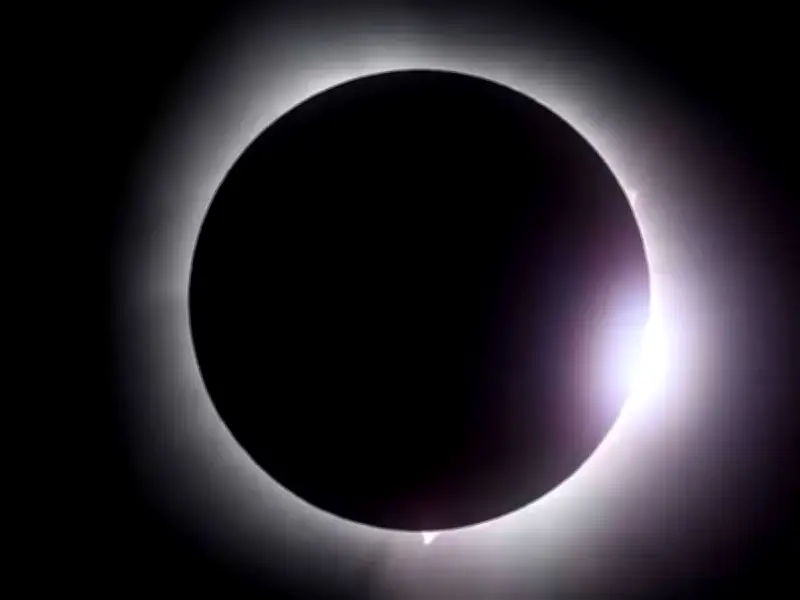
On Wednesday, August 12, a partial solar eclipse will be visible across the UK, with the Moon covering approximately 90% to 96% of the Sun at its peak. This will be the most substantial solar eclipse since 1999, according to Royal Museums Greenwich.
Timing and visibility
Just after 6pm, the Moon will begin to cover the Sun, leaving a downward-facing crescent that will thin over the following hour. The eclipse is expected to last for two hours, with most people in the UK seeing it during a 20-minute window.
Best viewing locations
Exeter will enjoy the UK's greatest percentage of solar coverage, with the Moon predicted to shield 94% of the Sun. The eclipse there is scheduled to begin at 7.15pm. London and Cardiff will both observe the eclipse at 7.13pm, with Cardiff seeing 93.2% coverage compared with 91.4% in London. Edinburgh and Scotland will be the first to witness the eclipse, starting at 7.05pm and 7.06pm respectively.
Across Europe, observers in France, Belgium, Switzerland, and northern Italy will see between 88% and 95% coverage, while parts of Greenland, Iceland, and northern Spain will experience a total eclipse.
Maximum eclipse by UK city
- Edinburgh: 90.7% - 7.05 PM
- Glasgow: 91.4% - 7.06 PM
- Belfast: 93.1% - 7.08 PM
- Leeds: 90.8% - 7.09 PM
- Manchester: 91.4% - 7.10 PM
- Liverpool: 91.8% - 7.10 PM
- Sheffield: 91% - 7.10 PM
- Birmingham: 91.8% - 7.11 PM
- Cardiff: 93.2% - 7.13 PM
- London: 91.4% - 7.13 PM
- Exeter: 94% - 7.15 PM
Where to watch and safety tips
Those hoping to witness the partial eclipse should seek a spot with a clear view towards the west or west-north-west, ideally on elevated ground without surrounding buildings and trees. In London, recommended locations include Hampstead Heath, Primrose Hill, and the Royal Greenwich Observatory.
It is crucial never to gaze directly at the Sun, even during an eclipse, as this can cause serious eye damage. The safest method is to use certified eclipse glasses that comply with the international safety standard (ISO 12312-2) or solar filters on telescopes, binoculars, or cameras. Verify that glasses carry the safety certification 'ISO 12312-2' or 'ISO 12312-2:2015'.