On August 12, 2026, a partial solar eclipse will be visible across the UK and Ireland, with the Moon covering approximately 90% to 96% of the Sun at its peak. This is the most significant solar eclipse in the region since 1999.
What to Expect During the Eclipse
The eclipse will begin at 6.17pm in London, with slight timing differences across the UK and Ireland. The Moon will gradually move across the Sun's disk, reaching maximum coverage at 7.12pm, when around 90% of the Sun will be obscured. At this point, there will be a noticeable drop in light levels and temperature, though the sky will not become completely dark. Conditions may resemble a cloudy day or the light around dawn or dusk.
After the peak, the Moon will slowly move away until the eclipse ends at 8.06pm. Since the event takes place around sunset, the Sun and Moon will be low in the western sky, so a high location with a clear view of the western horizon will provide the best viewing.
Visibility Across Europe
The eclipse will also be visible across much of Europe, including France, Belgium, Switzerland, and northern Italy, where around 88% to 95% of the Sun will be obscured. In parts of Greenland, Iceland, and northern Spain, a total solar eclipse will be visible, with the Sun completely hidden by the Moon.
Safety Warning for Viewing
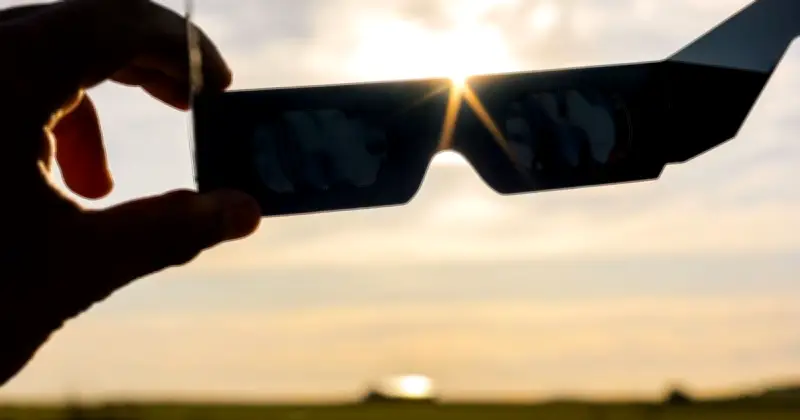
Experts warn that only special solar eclipse glasses certified to ISO 12312-2 should be used. Ordinary sunglasses, no matter how dark, should never be worn, as they reduce glare but still allow harmful solar radiation to reach the retina.
Following the 1999 total solar eclipse, the Royal College of Ophthalmologists reported around 70 cases of vision problems, with 40% having looked at the eclipse for less than a minute. Mohamed Elalfy, consultant ophthalmologist and president of the college, said: “The safest way to enjoy the eclipse is to observe it indirectly, such as by watching a live broadcast.”
Elalfy added: “Looking directly at the Sun during a solar eclipse can cause damage to the retina, potentially damaging the cells responsible for sharp central vision. Crucially, the retina has no pain receptors, so people will not feel the damage as it happens. Symptoms may only become apparent several hours later and can include blurred vision, a central blind or dark spot, distorted vision, reduced colour perception and increased sensitivity to light. While some people recover over weeks or months, others can be left with permanent visual impairment.”
According to Specsavers research, 10% of Britons have looked at a solar eclipse without eye protection before, and 19% incorrectly thought it was safe to view through a camera or smartphone screen. Optometrist Amelia Topping said: “Many people are unaware of the risks of looking at a solar eclipse without proper eye protection, but this can damage the retina and, in some cases, lead to permanent vision loss.”
Eclipse Timings Around the UK
According to the Royal Museum Greenwich, the eclipse timings are as follows:
First contact (Moon begins to cover the Sun):
- Edinburgh & Glasgow: 6:08pm
- Galway & Dublin: 6:12pm
- Manchester & Liverpool: 6:13pm
- Norwich & Birmingham: 6:15pm
- London, Bristol & Cardiff: 6:17pm
- Truro, Cornwall: 6:18pm
Eclipse maximum (greatest coverage):
- Edinburgh & Glasgow: 7:05pm
- Galway & Dublin: 7:10pm
- Manchester & Liverpool: 7:10pm
- Norwich & Birmingham: 7:11pm
- London, Bristol & Cardiff: 7:12pm
- Truro, Cornwall: 7:16pm
End of eclipse (Moon completely moves off the Sun):
- Edinburgh & Glasgow: 8:00pm
- Galway & Dublin: 8:05-8:06pm
- Manchester & Liverpool: 8:03-8:04pm
- Norwich & Birmingham: 8:04pm
- London, Bristol & Cardiff: 8:06pm
- Truro, Cornwall: 8:10pm
Additionally, the annual Perseid meteor shower will reach its peak on the night between August 12 and 13, offering stargazers an extra treat.