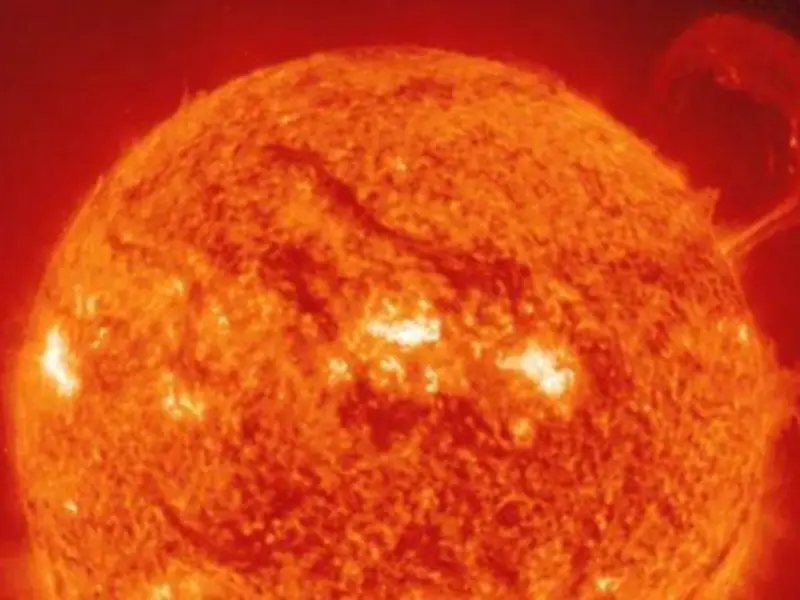
Scientists have predicted when the Sun will die, bringing an end to all life on Earth. While the Sun is expected to extinguish trillions of years in the future, several changes signalling the death of our Solar System will happen much sooner.
Scientists believe the Sun's "life" in its present stage, referred to as its "main sequence", will end in about five billion years from now. At its current stage, the nuclear fusion of hydrogen within the Sun enables it to emit energy and maintain sufficient pressure to prevent the star from imploding due to its own mass.
Sun's middle-age stage
Astrophysicist Paolo Testa, speaking to Live Science, said: "The Sun is a little less than five billion years old. It's a kind of middle-age star, in the sense that its life is going to be of the order of 10 billion years or so." Mr Testa is an astrophysicist at the Center for Astrophysics, a joint venture between the Smithsonian Astrophysical Observatory and Harvard College Observatory.

NASA explains: "In general, the larger a star, the shorter its life, although all but the most massive stars live for billions of years."
Transition to red giant
"Once the sun has consumed the majority of the hydrogen in its core, it will evolve into its subsequent phase as a red giant. Deprived of the energy production needed to support it, the core begins to collapse into itself and becomes much hotter."
Hydrogen is still available outside the core, so hydrogen fusion continues in a shell surrounding the core. "The increasingly hot core also pushes the outer layers of the star outward, causing them to expand and cool, transforming the star into a red giant."
This expansion will eventually engulf the Sun's closest planets, Mercury and Venus. In time, these gases will intensify the Sun's solar winds to such an extent that they obliterate Earth's magnetic field and strip away its atmosphere, extinguishing all life on Earth.
How scientists predict the Sun's death
To accurately forecast the death of a sun-like star, scientists need to understand how that star radiates energy. This was challenging until they learned to factor in nuclear fusion in solar masses.
Mr Testa explained: "A lot of the science is relatively new, like in the last century, because an integral part of understanding how a star works come from understanding nuclear reactions and fusion." "Before the Thirties, one of the main ideas of how stars worked was that energy was coming just from gravitational energy."
"By putting together lots of different information from lots of different stars, astronomers and astrophysicists could build a model for how stars evolve." "This gives us a rather precise guess of how old the Sun is."
These methods enable scientists to accurately determine when our Sun is due to implode.