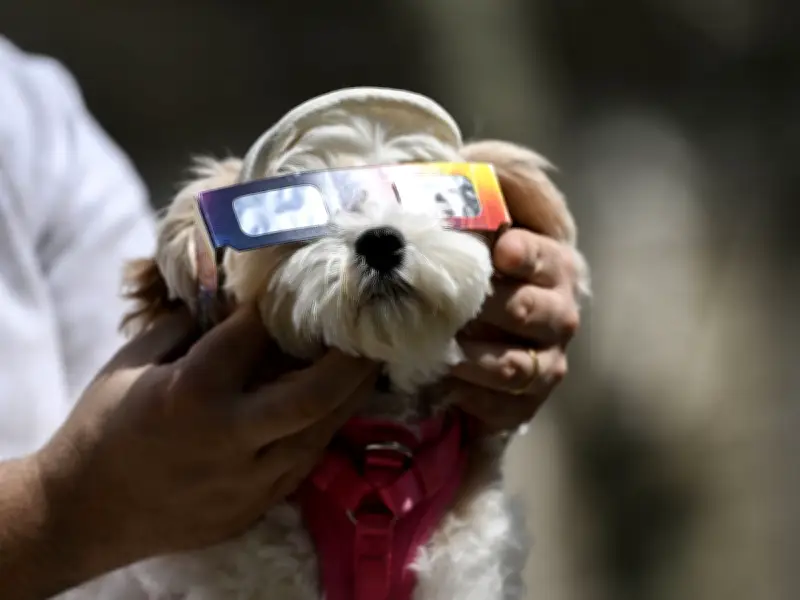
Scotland is just days away from witnessing its most dramatic solar eclipse since 1999, and if you're planning to watch the event, experts are urging people to buy eclipse glasses before they sell out.
Every major eclipse sees certified eclipse glasses disappear from shelves in the run-up to the event, while counterfeit products often appear on online marketplaces, raising concerns that unsafe glasses could damage people's eyesight.
On Wednesday, August 12, the Moon will pass between the Earth and the Sun, creating a spectacular partial solar eclipse across Scotland. The west of the country will enjoy the deepest views, with the Isle of Barra expected to see around 93% of the Sun covered, while Glasgow will experience around 91.4% coverage and Edinburgh around 90.7%.
Where to buy eclipse glasses in Scotland
If you haven't already bought eclipse glasses, now is the time, as demand is expected to increase sharply before August 12.
Independent opticians
Many independent opticians across Scotland stock certified eclipse glasses ahead of major astronomical events. Availability varies, so it's worth calling your nearest practice before making a special journey.
National optical retailers
Selected branches of Specsavers, Boots Opticians and other major optical chains may also have certified eclipse viewers available. Stock levels differ by location and are likely to become increasingly limited in the days before the eclipse.
Museums and observatories
Science museums, observatories and astronomy visitor centres are among the most reliable places to find genuine eclipse glasses. Museum gift shops sometimes stock certified solar viewers ahead of major celestial events.
Trusted online astronomy retailers
If you're buying online, choose established astronomy retailers or reputable science suppliers rather than unfamiliar third-party marketplace sellers. Make sure to check delivery dates so your glasses arrive before eclipse day.
How to spot fake eclipse glasses
Experts warn that fake eclipse glasses regularly appear online before major eclipses.
Only eclipse glasses or handheld solar viewers that meet the international ISO 12312-2:2015(E) safety standard should be used.
Before buying, check for:
- ISO 12312-2 certification.
- The manufacturer's name and contact details.
- Instructions explaining safe use.
- Packaging that appears professionally printed and unopened.
Avoid products that are unusually cheap, have no manufacturer information or lack safety markings. Ordinary sunglasses, no matter how dark they are, do not provide enough protection to safely view the Sun.
Never look directly at the Sun
Even with more than 90% of the Sun covered across much of Scotland, it is never safe to look directly at a partial solar eclipse without certified eye protection.
Looking at the Sun without the correct filters can permanently damage the retina, often without causing any immediate pain or warning.
Anyone planning to use binoculars, telescopes or cameras should also make sure they have specialist solar filters fitted.
No eclipse glasses? You can still watch safely
If eclipse glasses have sold out, there are still safe ways to enjoy the event.
A simple pinhole projector made from a piece of card allows you to project an image of the eclipsed Sun onto another surface without looking directly at it. Many astronomy organisations are also expected to livestream the eclipse online.
What time is the solar eclipse in Scotland?
Timings vary slightly depending on where you are in Scotland.
On the Isle of Barra, the eclipse will begin at around 6.05pm, reach its maximum at around 7.03pm when approximately 93% of the Sun will be covered, before ending at around 7.58pm.
In both Glasgow and Edinburgh, the eclipse will start at around 6.08pm. Glasgow will reach its peak at around 7.06pm with around 91.4% coverage, while Edinburgh will see its maximum at around 7.05pm with approximately 90.7% of the Sun obscured. In both cities, the eclipse is expected to end at around 8pm.
Best places to watch the eclipse in Scotland
The Isle of Barra in the Outer Hebrides is expected to offer Scotland's best view of the eclipse.
Because it lies farthest west and closest to the path of totality, Barra is forecast to experience around 93% coverage, making it the country's top location for skywatchers.
Elsewhere along the west coast, the Outer Hebrides, Isle of Skye and the Ayrshire coast are all expected to provide outstanding viewing conditions thanks to their uninterrupted views across the Atlantic and Firth of Clyde.
In Edinburgh, where around 90.7% of the Sun will be obscured, popular viewing locations include Arthur's Seat, Calton Hill, where the Astronomical Society of Edinburgh is expected to host a public viewing event using solar telescopes, and Blackford Hill beside the Royal Observatory Edinburgh.
Meanwhile, Glasgow is forecast to enjoy around 91.4% eclipse coverage. Some of the city's best vantage points include Cathkin Braes, the highest point in the Glasgow area, Loch Lomond Shores, which offers expansive views across the water, and the flagpole viewpoint in Queen's Park.
Because the eclipse takes place shortly before sunset, the Sun will be very low above the western horizon. Experts recommend choosing an elevated location or somewhere with a clear, uninterrupted view towards the west or north-west to enjoy the best possible view.