Manchester United's return to the Premier League is little more than a week away. The Reds travel to newly promoted Hull City on Saturday, August 22, as they begin a new season that shall include a return to the Champions League.
United aim to challenge in every competition this season, but one of their top priorities will be to finish in the top four, as a bare minimum. In order to be successful in the Premier League, the Reds will be forced to obey certain rule changes and restrictions that have been introduced this summer.
With this in mind, MEN Sport has taken a look at the changes to the Premier League this season that United fans must be aware of.
Time Wasting Measures
The Premier League is also looking to clamp down on time wasting in the top flight this season. A five second countdown will be introduced at the referee's discretion should a throw-in or goal kick be deemed to be wasting time. If the five second countdown is exceeded, the opposition will either receive a throw-in of their own or a corner, in the instance of a goal kick.
Players will now have 10 seconds to leave the pitch after they are replaced. If a player does not leave the pitch inside 10 seconds, the substitute cannot enter the pitch for at least one minute and will only be waved on at the next stoppage of play after the minute has elapsed.
Managers will not be able to cancel the substitution after the 10 seconds have been surpassed.
Transfer Restrictions
United can register 25 players for the Premier League. Eight players from that allowance need to be homegrown, with 17 non-homegrown. Players aged 21 or under (born on or after January 1, 2005) do not count towards that allowance.
Homegrown players are "irrespective of nationality or age, has been registered with any club affiliated to The Football Association or the Football Association of Wales for a period, continuous or not, of three entire seasons, or 36 months, before his 21st birthday (or the end of the season during which he turns 21)." This allowed Amad to be a homegrown player for United, despite representing the Ivory Coast and not starting his career in England.
The Reds' squad has changed this year with Patrick Dorgu now needing to take up a non-homegrown registration spot as he is no longer deemed a U21 player. However, room has been made for him following Altay Bayindir's departure to Celta Vigo.
Financial Rule Change
This season, the Premier League will be replacing Profit and Sustainability Rules (PSR) with Squad Cost Ratio (SCR) and Sustainability and Systemic Resilience (SSR). SCR is a financial regulation that limits Premier League clubs’ on-pitch spending to 85 per cent of their football-related revenue and net profit/loss from player sales.
This is being introduced to bring the Premier League in line with UEFA's regulations, the aim being to hopefully simplify the process. For clubs in UEFA competitions, spending is capped at 70 per cent of their revenue. This means United must adapt their spending to that cap, rather than the Premier League's.
While on paper this may look like United are worse off, the increased revenue attached to being in the Champions League, means they can, theoretically, spend more money than a team not in that competition.
SSR will be made up of three stress tests that clubs shall undertake throughout the campaign. These are - Working Capital Test, Liquidity Test and Positive Equity Test.
To pass these tests, United must do the following:
- Working Capital Test - they must demonstrate for each month of the season, that their projected cash balances and qualifying working capital funds are at least £12.5m.
- Liquidity Test - they must ensure they have a 'liquid headroom' of zero or positive, after absorbing a £85m loss for this season and the following campaign. This is to brace a club for a scenario whereby they are relegated or fail to qualify for Europe. The test will include 40 per cent of the club’s squad market value as an asset.
- Positive Equity Test - they must demonstrate that their ‘Positive Equity Ratio’ (liabilities divided by adjusted assets) is less than or equal to 90 per cent in the 2026/27 season, 85 per cent in the 2027/28 season and 80 per cent from the 2028/29 season onwards.
VAR Adjustments
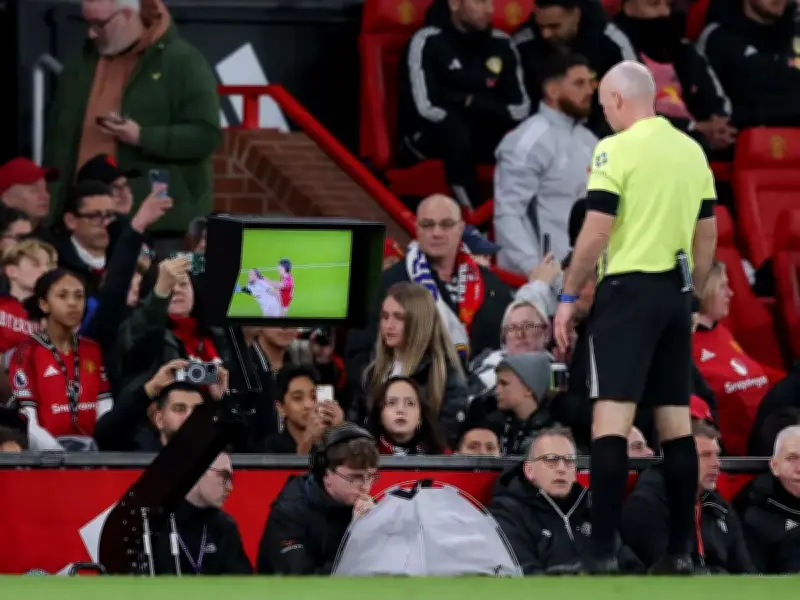
As part of the Premier League's 'Football Principles' for this season, the league has announced it remains committed to maintaining a 'high threshold' for VAR interference. This means VAR officials will continue to abide by the 'clear and obvious error' principle before deciding whether or not to recommend a review.
This season, the Premier League will be introducing a VAR review when second yellow cards are awarded to a player resulting in a red card. This shall only happen when the second yellow card is awarded, as opposed to whether one should be awarded or not.
At the World Cup, we saw VAR intervene if a corner was incorrectly awarded. That is not set to be implemented in the Premier League, this season.
Hair-Pulling Clarification
Last season, Lisandro Martinez was handed a three-match ban after he was deemed to have pulled Dominic Calvert-Lewin's hair during United's defeat to Leeds. In the wake of that, and other incidents last season, the Premier League has sought to clarify those rules.
A red card will now be issued if a player makes a 'clear and deliberate action' to pull an opponent's hair with 'excessive force and/or brutality'. Meanwhile, a yellow card will be issued if the player does not use 'excessive force and/or brutality'. This should account for accidental pulls of hair when reaching for an opponent's shirt, for instance.
Injury Treatment Time
Players were previously forced to leave the field for 30 seconds after receiving treatment on the pitch for an injury. This has now been increased to one minute.