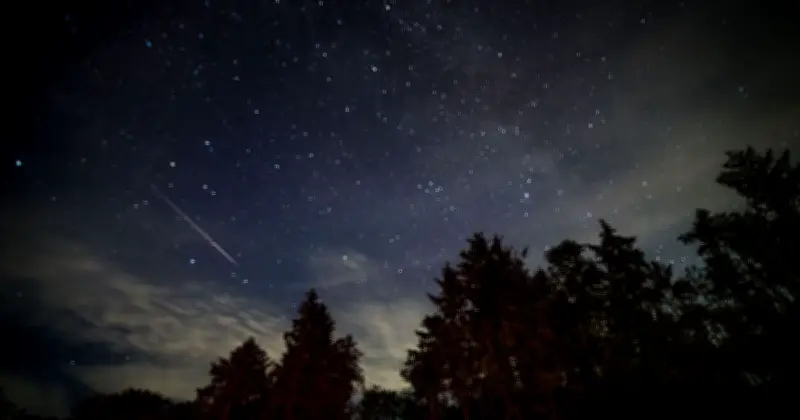
The Perseid meteor shower reaches its peak tonight, just hours after the UK's biggest partial solar eclipse in almost three decades. The annual display, regarded as one of the brightest and most reliable meteor showers of the year, will be most active overnight. Under ideal conditions, as many as 150 meteors an hour could streak across the night sky.
Best time to watch
The Royal Observatory Greenwich says people in the UK could begin spotting meteors as soon as the Sun sets because the Perseids' radiant remains above the horizon. However, the best viewing window is expected to be between midnight and 5.30am on August 13, when the greatest number of meteors should be visible.
The Observatory says moonlight often acts as natural light pollution, making fainter meteors harder to see, but that will not be a problem during this year's peak. This year's peak also coincides with a new Moon, creating ideal dark-sky conditions for observing the shower.
How to improve your chances
Experts recommend planning ahead and checking the weather forecast before heading out. For the clearest view, skywatchers should seek out areas with as little light pollution as possible, such as the countryside or a local park.
Allowing your eyes around 15 minutes to adjust to the darkness can also make fainter meteors easier to spot, while avoiding looking at a phone screen. The Observatory advises finding an open location with a clear view of the horizon and says binoculars or telescopes are unnecessary because meteors can appear anywhere in the sky. A stargazing app can also help locate the constellation Perseus, from which the meteors appear to originate.
What causes the Perseid meteor shower?
The Perseids are created when Earth passes through debris left behind by Comet 109P/Swift-Tuttle. As the tiny fragments enter Earth's atmosphere at extremely high speeds, the air in front of them becomes intensely compressed and heated, causing the particles to burn up.
Smaller pieces vaporise completely, leaving bright streaks of light across the night sky, while larger fragments can produce spectacular fireballs. The Perseids are considered one of the year's most impressive meteor showers because they regularly produce bright meteors, long glowing trails and a high number of visible shooting stars. The Royal Observatory Greenwich describes the annual event as one of the highlights of the astronomical calendar for meteor enthusiasts.
Myths and legends behind the Perseids
The Perseid meteor shower has inspired myths and folklore for centuries across different cultures. According to Greek mythology, the meteors are linked to the hero Perseus, who famously slew the Gorgon Medusa before marrying Andromeda. The name "Perseids" comes from the Greek word "Perseides", meaning the descendants of Perseus.
In some Catholic traditions, the annual display is also known as the "Tears of St Lawrence" because the shower's peak falls close to the feast day of the Christian martyr. Ancient Romans, meanwhile, associated the event with the fertility god Priapus, believing the annual meteor shower marked a time when he blessed the fields.
What about the solar eclipse?
More than 90% of the Sun will be obscured by the Moon between 6.17pm and 8.06pm this evening, the most it has been blocked above UK skies since the total eclipse in 1999. Devon, Cornwall and the westernmost parts of Pembrokeshire in Wales are set to see the eclipse at its fullest, with a range of 94% to 96% of the sun obscured by the moon.
Plymouth in particular is forecast to see the moon cover 94.66% of the sun at 7.16pm on Wednesday, according to the Met Office. The rest of Wales, Northern Ireland, parts of the West Midlands and the South West, and the westernmost parts of Scotland can expect to see 92% to 94% solar coverage.
In Cardiff, the moon is forecast to obscure 93.24% of the sun at 7.13pm while in Belfast it will cover 93.09% of the sun at 7.08pm. Skygazers in the rest of the UK will likely see the moon obscure 90% to 92% of the sun – with 91.79% expected in Birmingham at 7.12pm, 91.41% in London at 7.13pm, 90.74% in Inverness at 7.03pm, 90.71% in Edinburgh at 7.06pm and 90.22% in Newcastle at 7.07pm.