Millions of people across the world will turn their attention to the sky today as a total solar eclipse takes place. There are between two and five solar eclipses each year, with a total eclipse taking place every 18 months or so.
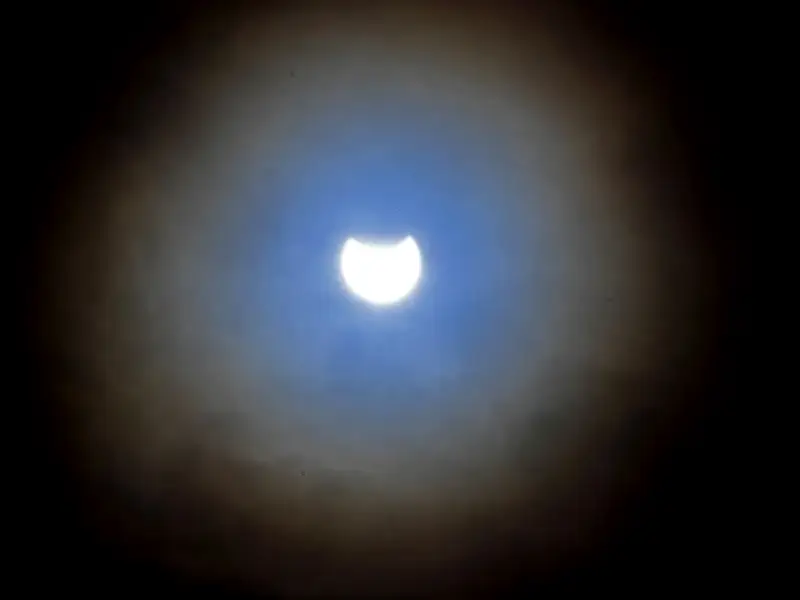
Anyone living in the UK and Ireland will see a partial solar eclipse this evening. This partial eclipse will almost be total, with around 90-96% of the Sun being obscured by the Moon at the maximum. The amount of coverage you'll see depends on your location.
You'll need a clear view to the western horizon to see the eclipse, as the Sun and Moon will be setting and low on the horizon. The last time the path of an eclipse's totality went over the UK was in 1999. This was one of the most viewed total solar eclipses due to its path falling on areas of high population density.
Visibility Across Europe
The eclipse will be special for other areas of Europe. According to Royal Museums Greenwich, viewers in areas of France, Belgium, Switzerland and northern regions of Italy will also be able to see around 88-95% coverage, while spectators in parts of Greenland, Iceland and Northern Spain will see a total eclipse.
Explaining exactly what happens during eclipses, NASA said: "A total solar eclipse happens when the Moon passes between the Sun and Earth, completely blocking the face of the Sun. People located in the centre of the Moon’s shadow when it hits Earth will experience a total eclipse."
The sky will darken, as if it were dawn or dusk. Weather permitting, people in the path of a total solar eclipse can see the Sun's corona, the outer atmosphere, which is otherwise usually obscured by the bright face of the Sun.
A total solar eclipse is the only type of solar eclipse where viewers can momentarily remove their eclipse glasses for the brief period of time when the Moon is completely blocking the Sun.
What Causes a Partial Eclipse
The space agency added: "A partial solar eclipse happens when the Moon passes between the Sun and Earth but the Sun, Moon, and Earth are not perfectly lined up. Only a part of the Sun will appear to be covered, giving it a crescent shape. During a total or annular solar eclipse, people outside the area covered by the Moon's inner shadow see a partial solar eclipse."
2090 will be the year when the next total solar eclipse is visible from the UK. Today's eclipse is the closest to total that the British Isles will see for 64 years. Royal Museums Greenwich said: "The only eclipse that comes close to total for the British Isles will be on September 3 2081, where up to 99% of the Sun will be obscured by the Moon."
Timing and Safe Viewing
Between approximately 6pm and 8pm on Wednesday, the moon will pass directly in front of the Sun resulting in a partial solar eclipse that will see up to 96% of the Sun covered in the UK. BBC Sky at Night Magazine has said Liverpool will see the partial solar eclipse from 6.13pm and 8.04 pm, with it expected to be at its peak at 7.10pm.
There will be live streams broadcast of the solar eclipse in the UK, but for those wanting to catch a glimpse in-person there are a number of ways to do so safely.
One of the most common ways is to use special eclipse glasses that block out the harmful rays. Another way to get a good view is making a pinhole projection, this will provide a good view of the Moon without actually looking at the Sun directly.
Easily made at home, pinhole projection works by using a small opening to project an image of a bright object onto a surface. They can be made using everyday items like a cardboard box, aluminium foil, paper and tape.