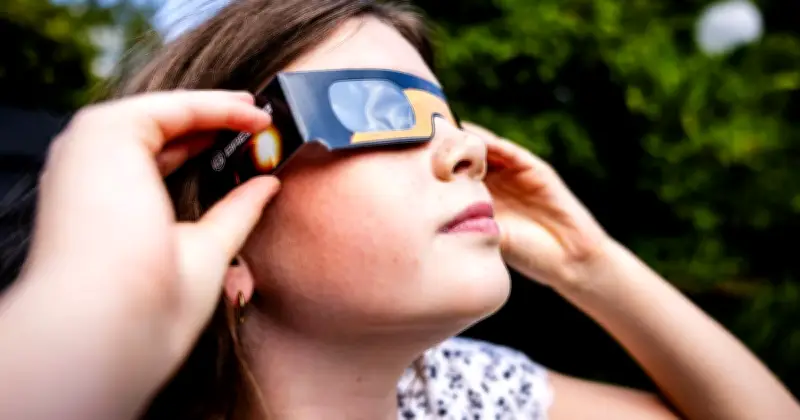
The Met Office has revealed where people across the UK will get the best view of a spectacular partial solar eclipse next week. Britons will be able to watch the celestial event on Wednesday, August 12, when the Moon passes between the Earth and the Sun, obscuring a large proportion of the solar disc.
Map shows coverage and times
A new map published by the Met Office shows how much of the Sun will be covered at the eclipse's peak in locations across the country, as well as the time at which maximum obscuration will occur.
The event comes 27 years after the famous solar eclipse of August 11, 1999, when millions of people looked to the skies as the Moon passed in front of the Sun. The 1999 eclipse was particularly memorable in the UK because a narrow path of totality crossed parts of Cornwall and Devon, where the Sun was completely obscured by the Moon. Elsewhere across Britain, people witnessed a partial eclipse.
Wednesday's eclipse will not bring totality
Wednesday's event will not bring totality to the UK, but large parts of the country will still see more than 90% of the Sun obscured at its peak, with the greatest coverage expected towards the south-west.
Speaking on its X account, the Met Office said: "The UK will experience a partial solar eclipse on Wednesday 12 August. The extent of the Sun's coverage and the timing of maximum obscuration will differ across the country. Never look directly at the sun; use a pinhole projector or certified eclipse glasses to view it."
Best places and times
- Plymouth – 94.66% at 7.16pm
- Cardiff – 93.24% at 7.13pm
- Belfast – 93.09% at 7.08pm
- Birmingham – 91.79% at 7.12pm
- London – 91.41% at 7.13pm
- Inverness – 90.74% at 7.03pm
- Edinburgh – 90.71% at 7.06pm
- Newcastle – 90.22% at 7.07pm
The map also indicates that parts of south-west Ireland will experience even greater solar coverage, although the Met Office's figures above highlight locations around the UK.
Safety advice
The eclipse will take place shortly before sunset, meaning anyone hoping to see it will need a clear view towards the western sky. The Met Office has stressed that people should never look directly at the Sun, even when most of it is obscured. Certified eclipse glasses or indirect methods such as a pinhole projector should instead be used to watch the event safely.