On Wednesday, the UK will experience a partial solar eclipse, with the Moon obscuring more than 90% of the Sun. The eclipse will happen between 6.17pm and 8.06pm, and is the fullest above UK skies since the total eclipse in 1999.
Here, the Press Association looks at the safest ways to watch the cosmic phenomenon, because looking directly at the eclipse can pose severe health risks.
Can I use sunglasses to watch the eclipse?
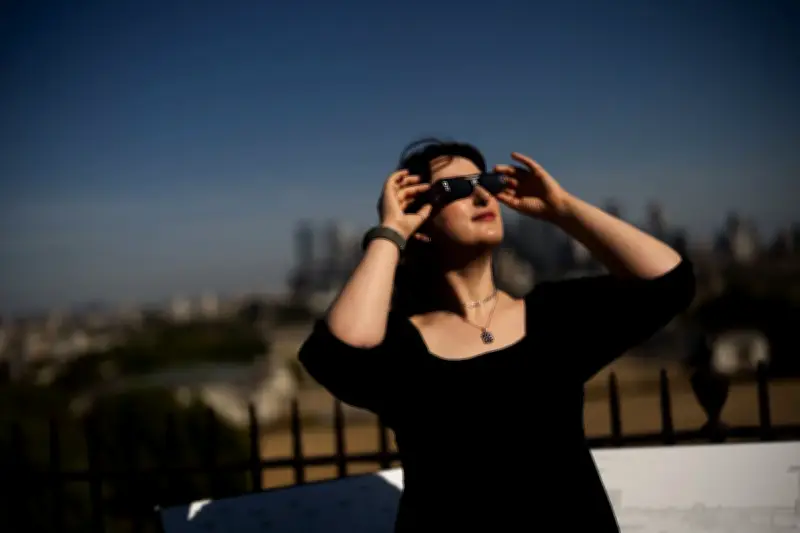
No, it is not safe to watch the eclipse using regular sunglasses. Only specialised eclipse glasses are safe to use. According to the National Aeronautics and Space Administration (Nasa), eclipse glasses are several thousand times darker than sunglasses, meaning they are safe for viewing the Sun.
If you have a pair of eclipse glasses, Nasa recommends inspecting them for damage before using and discarding the goggles if torn or scratched. The organisation also says you should not use eclipse glasses while looking through binoculars, camera lenses, or any other optical device, as the concentrated solar rays will burn through the glasses’ filter and could cause eye injuries.
What do I do if I cannot find eclipse glasses?
With so many looking to view the eclipse, glasses are in short supply. The Royal Greenwich Observatory has completely sold out of eclipse glasses while a viral social media clip from Tuesday evening showed queues around the block at one of the few remaining stores in London stocking the items.
If eclipse glasses are not available, Nasa suggests using indirect viewing methods. These do not involve looking directly at the Sun, but instead project the eclipse onto a nearby surface. For example, a pinhole projector can be made using a box, aluminium foil and a white sheet of paper. By taping foil and paper to both ends of the box, then punching a hole in the foil, you can indirectly view the Sun shining through the hole onto the paper.
During the different phases of the eclipse, you will be able to see the shadow from the Moon block out the light projected onto the piece of paper. If you do not have time to make a pinhole projector, Nasa suggests a good alternative is using a colander. By watching the shadow that the colander projects onto the ground, you can safely view the phases of the eclipse.
Can I use my phone’s camera to view the eclipse?
While using your phone’s front-facing camera to view the eclipse will not damage your eyes, it could destroy your device. In a post on X, Nasa said that pointing your phone’s camera directly at the Sun could damage its image sensor. The organisation added that using magnifying lenses attached to the phone camera would increase the risk of damage. Nasa suggested using a solar filter or holding a pair of eclipse glasses in front of your phone’s lens to protect the sensor from damage.
Why is it dangerous to look at the Sun during an eclipse?
Normally when we glance at the Sun, the brightness prevents us from looking too long and damaging our eyes with solar radiation. However, while eclipses might appear less bright, the UK Health Security Agency explains that solar radiation is just as dangerous as during any other day. This leads to people being mistaken that it is safe to look at the Sun during an eclipse.
Mohamed Elalfy, president of the Royal College of Ophthalmologists, said: “Looking directly at the Sun during a solar eclipse can cause damage to the retina, potentially damaging the cells responsible for sharp central vision. Crucially, the retina has no pain receptors, so people will not feel the damage as it happens.”
The college says that during the 1999 total solar eclipse, around 70 people experienced vision problems, with 40% of cases looking at the Sun for less than a minute.
How do I know if I have damaged my eyes, and what should I do?
Unsafely viewing the eclipse can lead to temporary or permanent visual impairment. According to the Royal College of Ophthalmologists, symptoms include blurred or distorted vision, a central blind or dark spot, reduced colour perception, and increased sensitivity to light.
Symptoms can become apparent several hours after looking at the Sun, meaning people viewing the eclipse unsafely may not know immediately if they have injured themselves. If you notice a change in your vision after watching the eclipse, you should promptly seek advice from an eyecare professional.
Where are the best places in the UK to watch the eclipse?
According to the Met Office, the best places to watch the eclipse are Cornwall, Devon and the western tip of Pembrokeshire, Wales. In these regions, between 94% and 96% of the Sun will be covered. Meanwhile, the website for Tresco Island, in the Isles of Scilly archipelago, claimed that Scilly will be “the very best place in the country” to witness the eclipse. The isles are located off the westernmost tip of Cornwall, meaning they will experience very high levels of coverage.
The Met Office said the majority of Wales and Northern Ireland will see between 92% and 94% coverage while for London, Manchester and the majority of Scotland between 90% and 92% of the Sun will be covered. Meanwhile, the worst view of the eclipse will be from Orkney and Shetland, as well as parts of the east coast of England and Scotland. These areas will only see between 88% and 90%.