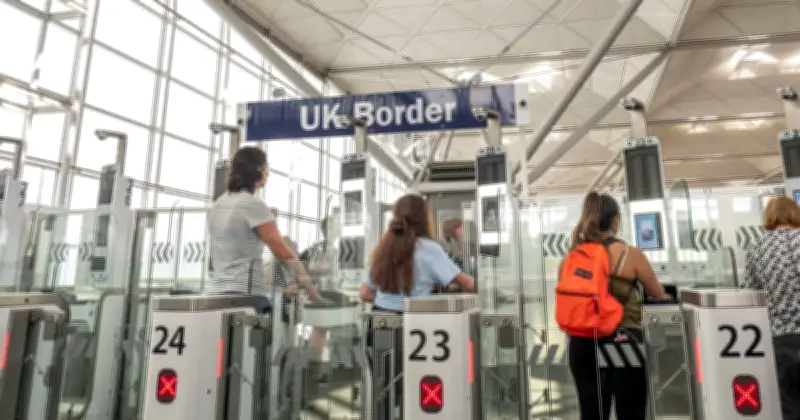
The Home Office has extended the age limit for eGates to include children aged eight and nine, a change now in force at 13 airports across the UK. The policy, introduced this year, means up to 1.5 million additional children will be able to use the eGates, based on 2025 UK airport arrival figures, helping to speed up journeys for families.
Who can use the eGates
The new rules, which were introduced from July, mean children aged eight and nine who are at least 120cm (3ft 11in) tall and accompanied by an adult are now eligible to use the eGates when returning to the UK from abroad. eGates are designed to speed up border checks through a digital passport scan rather than a manual inspection, but children need to meet the minimum height requirement so they can be seen by the biometric scanners, which use facial recognition technology to check passengers’ identities against the photo in their passports.
Under previous rules, passengers under the age of 10 were banned from using the gates, forcing families to queue at passport booths for manual inspections, which is generally a lengthier process.
Airports covered
The expansion of eGates to younger children applies across 13 major UK airports, and the Home Office said the expanded access, which began on July 8, covers more than 290 eGates in the UK, as well as at ports in Brussels and Paris, where juxtaposed checks take place. The 13 airports are Birmingham, Bristol, Cardiff, East Midlands, Edinburgh, Gatwick, Glasgow, London City, London Heathrow, Luton, Manchester, Newcastle and Stansted.
Commenting on the change earlier this year, Minister for Migration and Citizenship Mike Tapp said: “Travel with young children can be stressful for parents. By expanding eGate access, more families can experience a swifter and smoother journey home – freeing up precious time this summer holiday season. We are delivering continued improvement to the passenger experience, while keeping our borders safe and secure.”
Contactless upgrade ahead
According to the Government, using an eGate typically takes “just minutes”, and the rule change this July will allow more people to use them, which in turn is expected to reduce queue times through passport control. UK e-gates are available to Britons as well as nationals from the European Union, Australia, Canada, Iceland, Japan, Liechtenstein, New Zealand, Norway, Singapore, South Korea, Switzerland and the US.
The Home Office added: “The announcement is the latest step in UK border transformation, delivering smooth journeys for passengers and protecting border security. As of February, the Electronic Travel Authorisation (ETA) scheme has been enforced, providing a fuller picture of those seeking to come to the UK. Almost 25 million (24.8 million) ETAs have been issued since their introduction. The ETA scheme takes us one step closer to a contactless border. Contactless border will see state‑of‑the‑art facial comparison technology verify identity, rather than needing to present a passport. This is all whilst keeping our country’s borders secure.”
The Home Office announced further eGates changes this month, with new contactless technology to be introduced at these same 13 airports from October 6 to help speed up security checks and deliver smoother journeys for passengers. Passengers arriving in the UK will soon pass through airport eGates securely without having to show their passport, with the new contactless system upgrade due to complete at every eGate by early 2027.
Rather than having to manually scan passports at eGates, or show them to Border Force officers, passengers will instead simply approach the eGates and have their photo taken. The system will then check this live image against verified immigration, travel and passport information, and the eGate will then open automatically once these checks are complete. The Home Office said the contactless system uses state-of-the-art facial comparison technology to verify a passenger’s identity before the UK’s robust border security checks are carried out in full. Legitimate travellers can then simply walk through, without needing to place their passport on the eGate reader.
If further checks are required, passengers will then have to place their passport on the reader or they may be directed to a Border Force officer, as is currently the process. Border Force officers will continue to monitor all eGates to offer assistance and passengers are advised to keep their passports with them at all times.