Stargazers across Wales will be able to watch the Harvest Moon rise this evening, just three days after the autumn equinox officially welcomed astronomical autumn.
September's full Moon reaches its exact fullest point at 5.49pm on Saturday, September 26, but it will still be below the horizon across Wales at that time. Instead, sky watchers will need to wait until the Moon rises shortly afterwards.
In Cardiff, moonrise is expected at about 6.39pm, meaning the Moon will appear in the eastern sky less than an hour after reaching its full phase. The precise moonrise time varies depending on location, so people elsewhere in Wales may see it appear slightly earlier or later.
Why is it called the Harvest Moon?
The September full Moon is known as the Harvest Moon because it is the full Moon closest to the autumn equinox. The name has historical links to farming, with the additional moonlight around this time of year traditionally giving farmers more light in which to gather crops after sunset.
The Harvest Moon can occur in October in some years if October's full Moon is closer to the equinox. This year's full Moon falls only three days after the equinox, which took place at 1.06am on Wednesday, September 23.
Why could the Moon look orange?
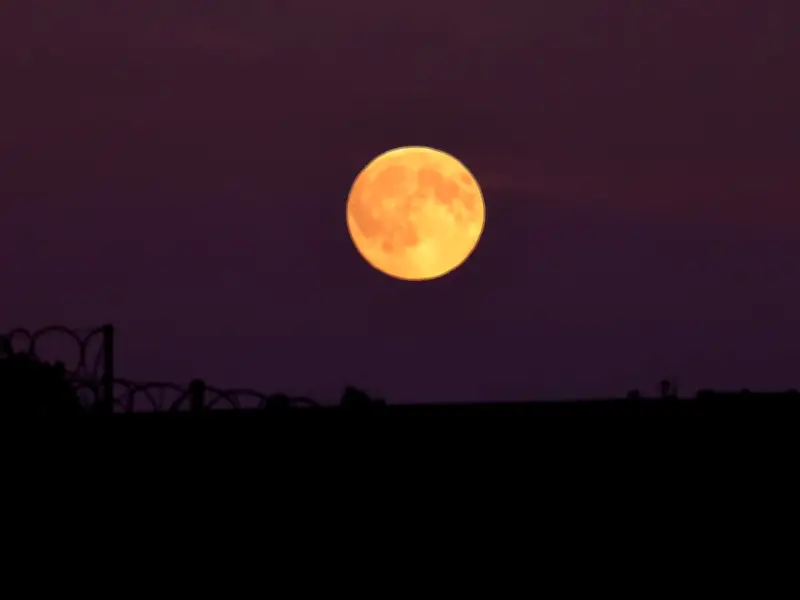
People watching the Moon as it rises may notice that it appears yellow, orange or even reddish. This is not because the Harvest Moon itself has a different colour.
When the Moon is close to the horizon, its light travels through more of the Earth's atmosphere before reaching our eyes. The atmosphere scatters shorter blue wavelengths of light more strongly, allowing more of the yellow, orange and red light to be seen. The effect can make a low Moon particularly photogenic.
Autumn has officially arrived
The Harvest Moon comes just days after the astronomical start of autumn. The equinox marks the moment when the Sun crosses the celestial equator. In the Northern Hemisphere, it marks the beginning of astronomical autumn. Royal Museums Greenwich gives the precise time of this year's equinox as 1.06am BST on September 23.
Despite the name "equinox", day and night are not actually exactly equal on the day itself. This is partly because the Sun appears as a disc rather than a point and because the Earth's atmosphere bends sunlight, meaning daylight lasts slightly longer than 12 hours. The date when day and night are closest to equal is known as the equilux, and it occurs a few days after the equinox in the UK.
Will you be able to see it?
Cloud cover will ultimately determine how good the view is for stargazers in Wales. Anyone hoping to photograph the Moon should look for breaks in the cloud around the time of moonrise and choose somewhere with an unobstructed view towards the eastern horizon.
There is no need to be outside at precisely 5.49pm. That is the moment the Moon reaches its astronomical full phase – the useful viewing time for people in Cardiff is around 6.39pm, when it actually rises above the horizon.
So, if skies are clear, look east from around 6.40pm onwards tonight and you could catch Wales' Harvest Moon rising into the first Saturday night of astronomical autumn.