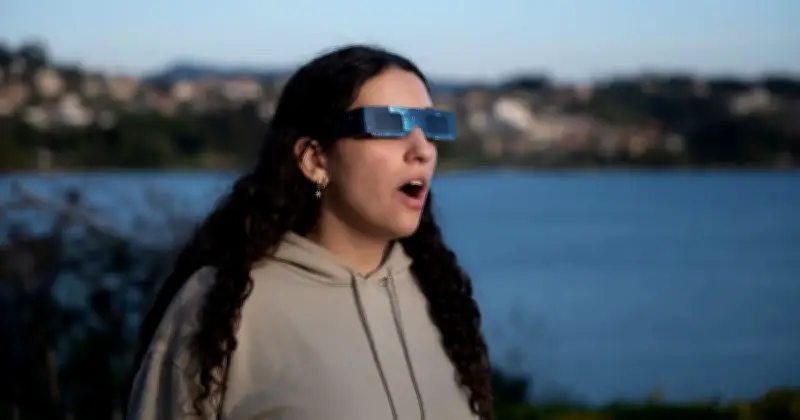
The UK is set to experience its greatest solar eclipse since 1999 on Wednesday, August 12, with a partial eclipse visible across the country. According to the Met Office, "On Wednesday the UK will experience its greatest eclipse since 1999 and there won’t be one as good as this viewable in the UK until 2081."
Five phenomena to watch during the eclipse
In a TikTok post, Dr Daisy Dobrijevic, a space journalist and content creator, highlighted five other things to look out for during the eclipse. She advised viewers not to just look at the sun but to also observe the following:
- At maximum eclipse, the moon will cover around 90% of the sun from parts of the UK, leaving a thin crescent. Eclipse glasses are essential for this stage.
- Near trees, tiny gaps between leaves act like pinhole projectors, casting hundreds of tiny crescent-shaped suns on the ground.
- Shadows may start to look unusually sharp or strange as the sun becomes a thinner crescent.
- Daylight can take on an unusual, eerie quality during a deep partial eclipse.
- You may feel the temperature begin to drop as less sunlight reaches the ground.
Dr Dobrijevic reminded viewers to use certified eclipse glasses to look directly at the sun throughout the entire eclipse.
Safety guidance for eclipse viewing
Advice on safely watching the eclipse is available in a UKHSA blog. The experts said: "Ordinary sunglasses - no matter how dark - do not provide adequate protection for viewing a solar eclipse. They reduce glare, making it feel more comfortable to look at the Sun for longer, while still allowing harmful solar radiation to reach the retina. Never use regular sunglasses to look at the Sun during an eclipse."
The guidance continued: "If you want to use eclipse glasses or handheld solar viewers, make sure they are genuine eclipse glasses with specially designed filters that meet the international safety standard ISO 12312-2:2015(E)."