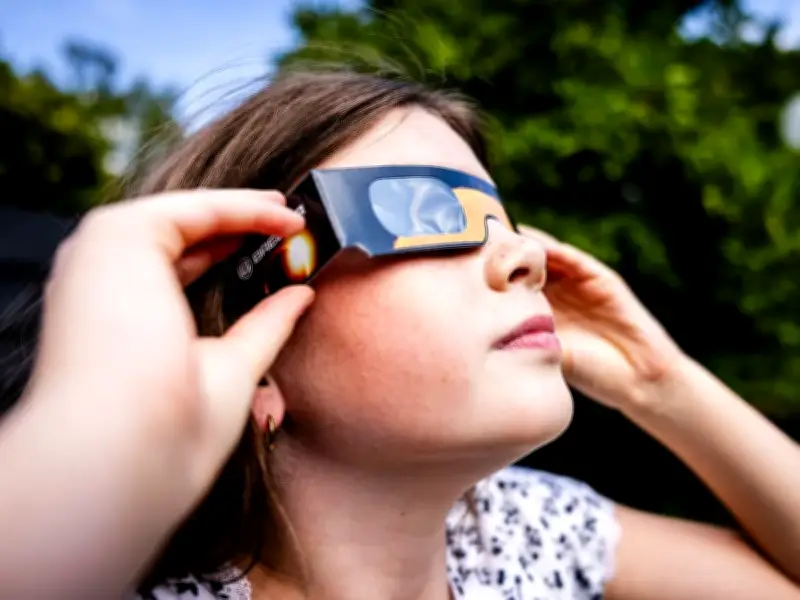
With the solar eclipse approaching, experts are warning the public about counterfeit protective eyewear. Eye doctors and astronomy specialists are urging eclipse watchers to use only certified solar eclipse glasses, as safety-approved options have largely sold out online.
Eclipse timing and visibility
The celestial event will occur on August 12, with more than 90% of the Sun blocked by the Moon between 6.17pm and 8.06pm. It is expected to be the most spectacular display since the total eclipse in 1999.
Specialists caution that only genuine solar eclipse glasses carrying ISO 12312-2 certification provide the safest eye protection. However, these have become scarce online or come with high delivery charges for next-day arrival.
Risks of improper eyewear
Experts stress that eclipse glasses lacking proper safety standards, or regular sunglasses—no matter how dark—must never be used to observe an eclipse. They reduce glare, creating the illusion it is safer to stare at the Sun for longer, while still allowing damaging solar radiation to reach the retina.
After the 1999 total solar eclipse, the Royal College of Ophthalmologists documented roughly 70 cases of vision problems, with around 40% of those affected having gazed at the Sun for under a minute.
Expert advice
Mohamed Elalfy, a consultant ophthalmologist and president of the Royal College of Ophthalmologists, said: "The safest way to enjoy the eclipse is to observe it indirectly, such as by watching a live broadcast. Looking directly at the Sun during a solar eclipse can cause damage to the retina, potentially damaging the cells responsible for sharp central vision."
He added: "Crucially, the retina has no pain receptors, so people will not feel the damage as it happens. Symptoms may only become apparent several hours later and can include blurred vision, a central blind or dark spot, distorted vision, reduced colour perception and increased sensitivity to light."
"While some people recover over weeks or months, others can be left with permanent visual impairment."
Warnings for parents and DIY methods
Kyla Black, Boots Opticians director of optical practice, urged parents to be "particularly careful" letting their children view the eclipse and warned that some DIY filters can be dangerous. She advised checking eclipse glasses for damage before use, as even a glimpse of damage could impact eyesight.
She also debunked the myth that multiple pairs of sunglasses can protect against harmful UV light, calling it "untrue and should be avoided at all costs." She cautioned against DIY filters made from cereal boxes, smoked glass, colour film, floppy disks, X-ray film, or dark sunglasses, as they cannot block invisible infrared and ultraviolet rays.
For those using cameras, binoculars, or telescopes, she stressed the need for approved solar filters and recommended contacting the manufacturer if unsure about safety.
Additional expert guidance
The Royal Observatory Greenwich also cautioned that ordinary sunglasses are not safe for viewing the event. Imo Bell, a planetarium astronomer at the observatory, previously told the Press Association: "It's not a total eclipse, but over 90% is really exciting. We're not going to get one this good for a really long time."
"So, it's important not to miss it, and to be prepared. You can't just go out and expect to have a look, because it's really dangerous for your eyes."
She recommended solar eclipse glasses, which block out so much light that only the Sun is visible, or a solar telescope. Alternatively, projecting the image using a household item like a colander can work: point it toward the Sun with your back facing it, and the eclipse will appear in the holes of its shadow.
Bonus: Perseid meteor shower
As an extra treat, the yearly Perseid meteor shower will peak on the evening of August 12-13. It occurs when Earth passes through debris left by Comet Swift–Tuttle. Tiny particles collide with the atmosphere at about 60 kilometres per second, creating brief flashes resembling shooting stars.