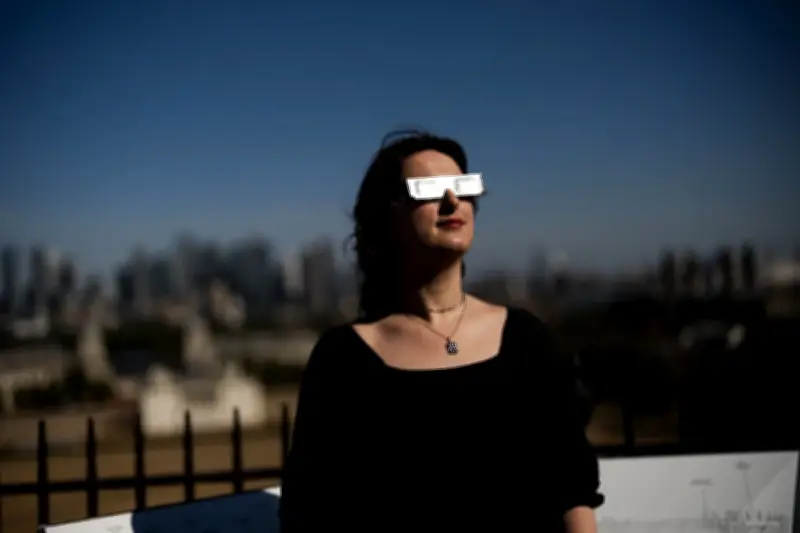
Specialist glasses have sold out at major retailers as Britons prepare for the best solar eclipse in decades. More than 90% of the sun will be obscured by the moon between 6.17pm and 8.06pm on Wednesday, the most it has been blocked above UK skies since the total eclipse in 1999.
Glasses sell out ahead of eclipse
Convenience stores, national parks and the Royal Greenwich Observatory have all exhausted their glasses supplies ahead of the eclipse, which will be the country’s fullest for the next 54 years. The Royal Greenwich Observatory told the Press Association it had sold approximately 15,000 pairs of eclipse glasses – a sellout – in the last month.
Meanwhile, consumers have been warned against using “knock-off” glasses to watch the event and eye doctors urged people to avoid looking directly at the sun, with even brief exposure causing lasting vision damage. Only special solar eclipse glasses that are ISO 12312-2 certified for the safest eye protection should be used to view the eclipse and sunglasses are not sufficient, experts said.
Eye doctors warn of vision damage
Following the 1999 total solar eclipse, the Royal College of Ophthalmologists reported around 70 cases of people experiencing vision problems after watching the eclipse. Around 40% had looked at it for less than a minute.
Mohamed Elalfy, a consultant ophthalmologist and president of the Royal College of Ophthalmologists, said: “The safest way to enjoy the eclipse is to observe it indirectly, such as by watching a live broadcast.
“Looking directly at the sun during a solar eclipse can cause damage to the retina, potentially damaging the cells responsible for sharp central vision.
“Crucially, the retina has no pain receptors, so people will not feel the damage as it happens.
“Symptoms may only become apparent several hours later and can include blurred vision, a central blind or dark spot, distorted vision, reduced colour perception and increased sensitivity to light.
“While some people recover over weeks or months, others can be left with permanent visual impairment.”
Best viewing spots and coverage
Devon, Cornwall and the westernmost parts of Pembrokeshire in Wales are set to see the eclipse at its fullest, with a range of 94% to 96% of the sun obscured by the moon. Plymouth in particular is forecast to see the moon cover 94.66% of the sun at 7.16pm on Wednesday, according to the Met Office.
The rest of Wales, Northern Ireland, parts of the West Midlands and the South West, and the westernmost parts of Scotland can expect to see 92% to 94% solar coverage. In Cardiff, the moon is forecast to obscure 93.24% of the sun at 7.13pm while in Belfast it will cover 93.09% of the sun at 7.08pm.
Skygazers in the rest of the UK will likely see the moon obscure 90% to 92% of the sun – with 91.79% expected in Birmingham at 7.12pm, 91.41% in London at 7.13pm, 90.74% in Inverness at 7.03pm, 90.71% in Edinburgh at 7.06pm and 90.22% in Newcastle at 7.07pm.
Those most keen to catch a sight of the fullest possible solar eclipse should avoid the easternmost parts of the UK, where only 88% to 90% of solar coverage is expected. These include the coasts of Norfolk, Yorkshire and Aberdeenshire, as well as the Orkney and Shetland Islands.
In an added bonus for stargazers, the annual Perseid meteor shower reaches its peak on the night of August 12-13, hours after the eclipse. The shower is produced as Earth ploughs through a stream of dust left behind by Comet Swift–Tuttle. Each tiny grain strikes Earth’s atmosphere at about 60 kilometres per second, burning up in a brief flash that takes the appearance of a shooting star.