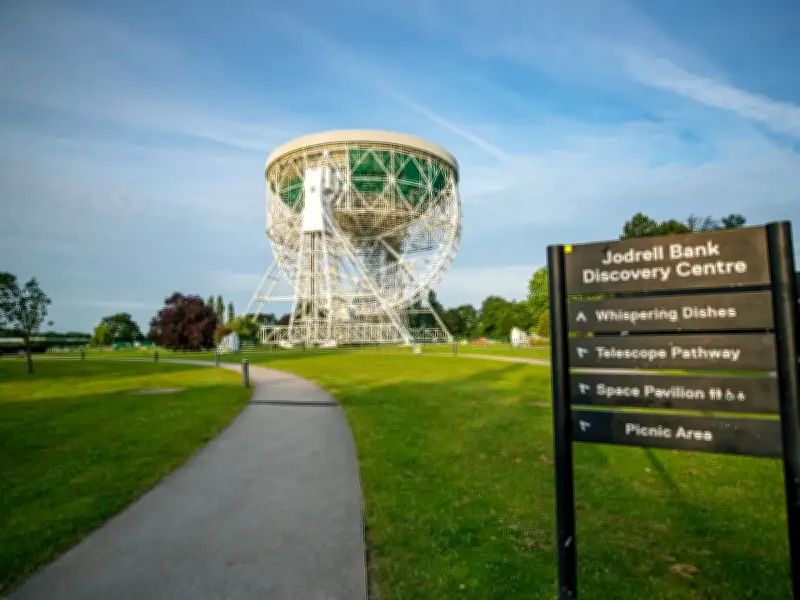
Campaigners are hoping to save Jodrell Bank Observatory in Cheshire, home to the Grade I-listed Lovell Telescope, after UK Research and Innovation confirmed it will withdraw funding for the e-MERLIN radio telescope network when the current agreement ends in March 2028.
For many people in Merseyside, the observatory is more than a scientific site; it is a place tied to school trips, childhood memories and the excitement of discovering space. Thousands of pupils from schools across Merseyside have visited for educational day trips, exploring the Discovery Centre, learning about planets and stars, taking part in workshops, and seeing the enormous Lovell Telescope up close.
Reaction to funding decision
Brian Cox, professor of particle physics at the University of Manchester, which hosts the observatory, described the funding cuts as “hasty and ill-considered”. The news, which came to light on 27 July, triggered 14 petitions within 48 hours, gathering thousands of signatures. The Manchester Evening News has also launched its own campaign.
History and significance
Standing since 1957, the Lovell Telescope is the largest telescope in the UK and the world's third-largest steerable radio telescope. In 1966, the first images from the Moon's surface were received at Jodrell Bank. During the Cold War, it provided a crucial four-minute warning of potential nuclear attack for five years. In recent decades, it has studied distant galaxies and contributed to discoveries involving black holes, quasars, pulsars and gravitational lenses. Today, Jodrell Bank is the lead site in the e-MERLIN array, a network of telescopes across the UK carrying out deep space research.
Fight for survival
Jodrell Bank said it remains "a major scientific, cultural and economic centre" and vowed to fight for its survival. In a message thanking supporters, the team said: "Thanks for your messages of support today - it's been moving to see how much Jodrell means to so many of you. While these cuts to e-Merlin's funding are significant, Jodrell Bank remains a major scientific, cultural and economic centre nationally and for the local area. We will be working with colleagues from The University of Manchester and other partners to secure the future of the Lovell telescope and e-Merlin."
As the observatory faces an uncertain future, campaigners are fighting to ensure future generations of pupils have the same opportunity to experience Jodrell Bank for themselves.