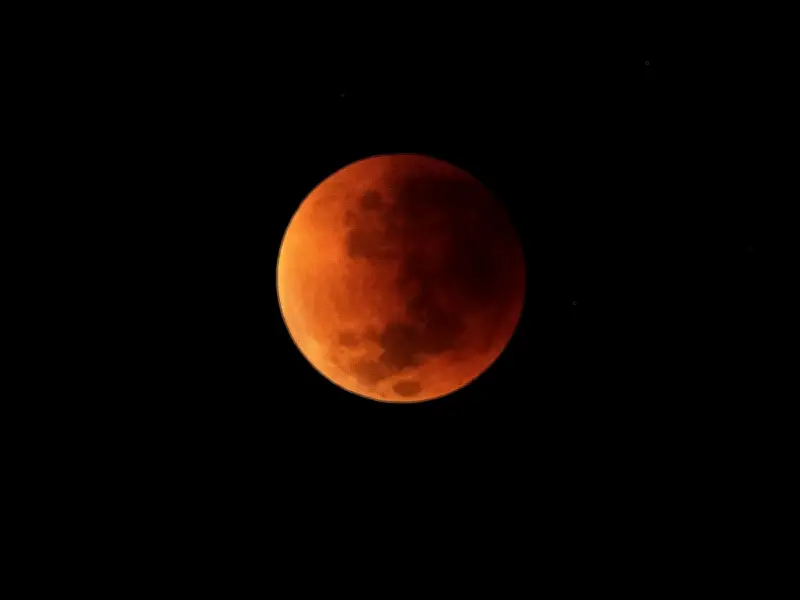
Stargazers across the UK are being offered the chance to witness a spectacular Blood Moon in the early hours of Friday, although cloudy weather could spoil the view for many.
A deep partial lunar eclipse will take place during the night, with the Moon expected to pass through Earth's shadow and turn shades of red as the event reaches its most dramatic stage. At its peak, around 93% of the Moon will be covered by the darkest part of Earth's shadow.
When will the eclipse reach its peak?
The lunar eclipse begins at 2.23am on Friday when the Moon enters the penumbra, the lighter outer section of Earth's shadow. The partial eclipse will begin at 3.33am as the Moon starts moving into the darker central shadow, known as the umbra.

The event is expected to reach its peak at 5.12am. At that point, around 93% of the Moon will be covered by the umbra, potentially creating the dramatic reddish appearance associated with a Blood Moon. The partial eclipse will continue until around 6.51am.
However, not everyone will be able to watch until the end of the event because the Moon will set before the eclipse is over in some locations. London is expected to lose sight of the Moon at around 6.15am.
Where will skies be clearest?
The Met Office has warned that viewing conditions will be difficult in many areas. Cloud is forecast across Cornwall and Devon, Wales, the Midlands, parts of north-west England, most of Scotland and Northern Ireland. There could also be patchy cloud across north-east England.
Southern and eastern England are expected to have the best chance of seeing at least part of the eclipse, especially before cloud becomes more extensive later in the night. A Met Office spokesperson said: "The greatest chance of seeing something is likely to be across southern and eastern England during its earlier stages, before cloud becomes more extensive."
"Elsewhere, any temporary breaks in the cloud could still provide brief views." Anyone hoping to maximise their chances should find a high vantage point with a clear and unobstructed view towards the south-western horizon.
Why can everyone see a lunar eclipse at once?
A lunar eclipse differs from a solar eclipse because it is not limited to a narrow path across the Earth's surface. A solar eclipse happens when the Moon blocks the Sun from the perspective of people in particular locations.
A lunar eclipse, on the other hand, occurs when the Moon enters Earth's shadow. That means everyone located on the night side of the planet can potentially see the event at the same time, provided the Moon is above the horizon and the skies are clear.
The eclipse will therefore take place simultaneously across the UK, even though the Moon's exact position in the sky will vary from place to place.
What causes the Blood Moon effect?
The Moon does not completely disappear when it passes into Earth's shadow. Instead, some sunlight travels through the Earth's atmosphere before being bent towards the lunar surface.
The atmosphere filters the light, scattering much of the shorter blue light while allowing redder wavelengths to reach the Moon. This can give the Moon its famous reddish, orange or copper appearance.
The eclipse is safe to watch without any specialist equipment or protective glasses, unlike a solar eclipse. All people need is a clear view of the sky and, ideally, an unobstructed view towards the south-west.