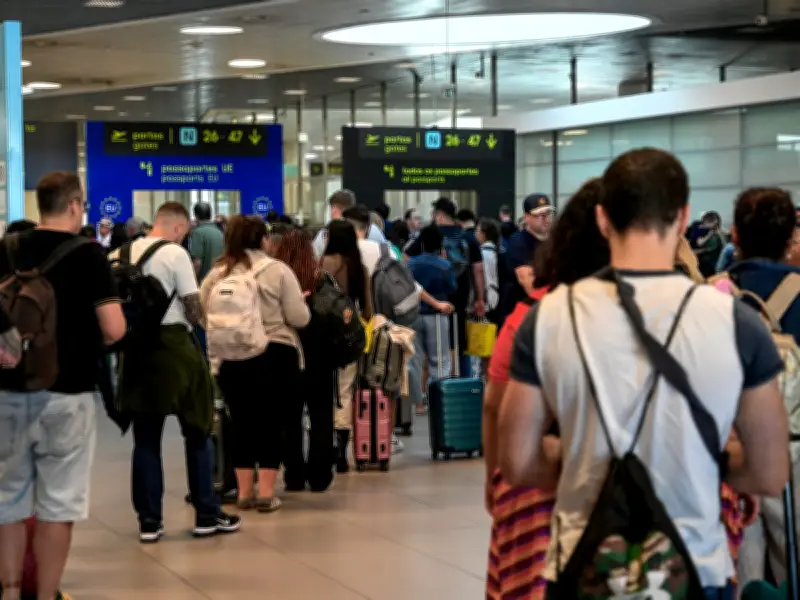
Rome Fiumicino Airport and Rome Ciampino Airport are considering waiving the EU's Entry/Exit System (EES) biometric requirements for British travellers this summer, following Greece's earlier exemption. The move aims to prevent severe disruption during peak travel months, with airport officials warning of potential 'disaster' if the system remains fully enforced.
Background on the Entry/Exit System
The EU's EES was fully rolled out on 10 April 2026, requiring all British passport holders entering the Schengen area to create a digital record and provide biometric data, including fingerprints and a photograph. The system replaced traditional manual passport stamping and is valid for three years after initial registration. However, its implementation has caused significant issues at European airports, with reports of Brits being asked to resubmit biometrics and facing queues of up to four hours, leading to missed flights and ruined holidays.
Greece's Exemption and Rome's Concerns
Greece became the first country to officially waive the biometric registration requirement for British travellers earlier this year. In an official statement, the Greek Embassy confirmed: 'In the framework of the implementation of the Entry/Exit System, as of 10 April 2026, British passport holders are exempt from biometric registration at Greek border crossing points.' The Foreign Office updated its travel advice accordingly, stating: 'Greek authorities have indicated that they will not collect biometric data (fingerprints and photos) for UK travellers as part of EES.'
Now, Rome's airports are looking to follow suit. Aeroporti di Roma Chief Executive Officer Marco Troncone told the Financial Times, 'We are very worried for the summer,' rating his concerns as an 'eight or nine' out of 10. He added: 'The process proves to be incompatible with the peak volumes that we are going to face. So the only way is to open up the valve. There is no way that we can deliver 100% of the enrolment.'
EU Flexibility for Summer
An EU official has indicated that European airports could relax EES requirements until September 2026 to manage summer crowds. Uku Särekanno, Deputy Executive Director of Frontex, which helps manage the EU's external borders, said earlier this month: 'We have until the end of the summer, the possibility during the tourism season to lift the biometric controls or the biometric registration temporarily.' He added: 'If there is a peak hour, you see that there are hundreds of people queuing, their queues are getting too long, then member states still have the possibility to lift biometric registration. The EU has considered, for the period of summer, to make sure that there is still some relief for the worst-case scenario.'
Current Status and Schengen Area
Despite Rome's considerations, Greece remains the only country to have officially eased the requirements for British travellers. The Schengen area includes 27 countries: Austria, Belgium, Bulgaria, Croatia, Czechia, Denmark, Estonia, Finland, France, Germany, Greece, Hungary, Iceland, Italy, Latvia, Liechtenstein, Lithuania, Luxembourg, Malta, Netherlands, Norway, Poland, Portugal, Romania, Slovakia, Slovenia, Spain, Sweden, and Switzerland. The EES is not required for travel to the Republic of Ireland or Cyprus, as they are not part of the Schengen area.
Major Greek airports where the exemption applies include Athens International Airport, Thessaloniki International Airport, Kalamata International Airport, Aktion National Airport, and island airports such as Corfu International Airport, Kefalonia International Airport, and Zakynthos International Airport.