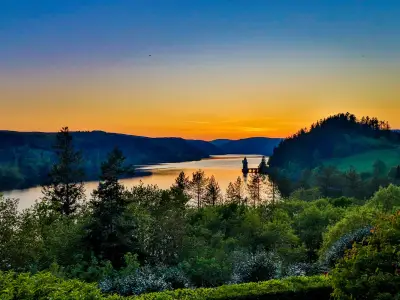
At 5am on Arkösund bay, it is so light it could be midday. I slip out of the pretty clapboard Arkösunds hotell, opened in 1895, as a small boat putters into the Baltic Sea, the sun sparkling on its calm waters. A wooden boardwalk invites me on to a string of tiny islets as geese arrow overhead and a mother swan coaxes her fluffy cygnets into a nook under a bridge.
I’m on Sweden’s east coast to explore the Östergötland archipelago, a sprawl of about 9,000 islands scattered across the Baltic Sea a few hours south of Stockholm. Quieter and less crowded than the better-known isles off Stockholm or Gothenburg, it covers several pockets of coastline and smaller archipelagos: Arkösund, Sankt Anna, Gryt and Tjust. The larger islands are flecked with traditional red timber summer houses, and are home to seals, sea birds, and dense, verdant forests of alder, cedar, oak and pine.
I’d arrived in a suitably slow fashion. My journey to Arkösund – a 45-minute drive from Norrköping station along a road locals call the End of the World – started 24 hours earlier, with an early morning Eurostar from London to Brussels, then on to Hamburg via Cologne, where I boarded the SJ EuroNight Train to Norrköping. I slept while we slipped across the Danish border in the early hours and crossed the Øresund Bridge into Sweden. Dawn unfolded in pink, dusky waves as we shuddered out of Malmö towards Östergötland.

Navigating the islands
Visitors navigate the region’s islands in sailboats, small motorboats or kayaks, spending elongated summer days swimming, fishing and hiking. From Arkösund jetty, I take to the water with Åsa, a local guide, in a motorboat belonging to Kauko Lindstedt, a Finn who has spent 40 years living on the island of Aspöja, a four-mile crossing away. There is an unspoken rule, Åsa says, that if you spot a moored kayak or boat, move on. In the Swedish spirit of allemansrätten – the national law to roam and sleep freely in nature – there are enough islands for everyone.
Aspöja is one of the few inhabited islands and Lindstedt, as with many islanders I meet, is industrious: building, hunting, smoking fish, running boating tours, and eager to share his home, where just 25 people live year-round. We land at his jetty and walk across grassy meadows dotted with lumps of granite and teeming with butterflies. There are no cars, though the jetty has a communal wheelbarrow for groceries and post. We meet Helen, who farms sheep and cattle, knits, tans sheepskins, keeps bees, grows vegetables and runs the only restaurant, Forsmans på Aspöja, with her daughter. Lunch is smoked fish and boiled potatoes heaped with fresh dill, alongside a glass of Baltic seawater, filtered through the island’s small desalination plant.
On the trip back to the mainland, we pass an island stacked with fishing nets, buoys and wooden crates. A pair of craggy-faced men wave – brothers in their 70s, the final vestiges of a once thriving fishing industry, Åsa tells me. They are the last two fishers legally able to catch eels; the licence can only be passed on through family, and with none it ends with them.
Sankt Anna and kayaking
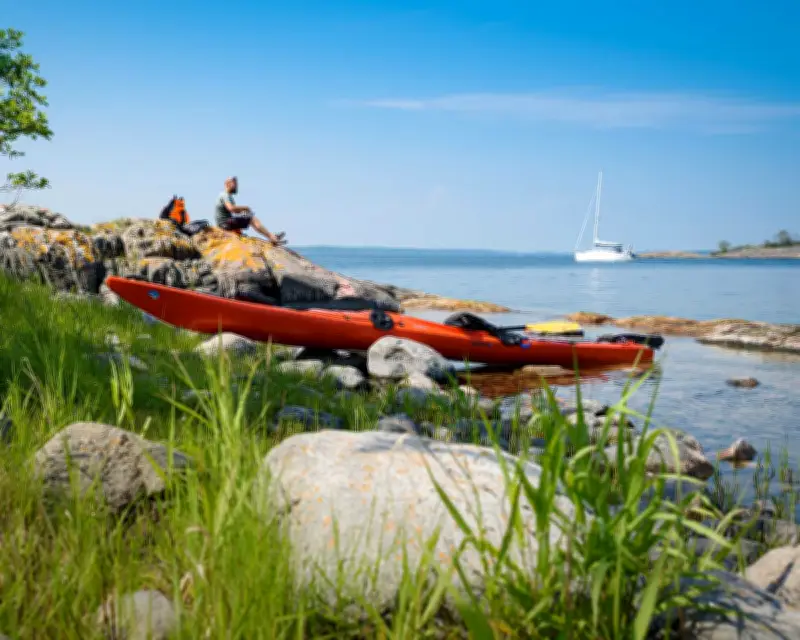
The next day, Åsa and I drive further along the coast to the Sankt Anna archipelago, stopping for lunch at Mauritzberg Castle, a 400-year-old manor house rebuilt in pastel rococo splendour after the Russians burned it down in 1719. At the bay of Sankt Anna, I meet a German tourist packing his kayak for a 10-day solo adventure. He tells me he paddles for days from island to island without seeing a single soul and adores it – it’s his third trip here.
From the shore I clamber into a kayak alongside Andreas, my guide, another Finn who works for outfitter Kajakparadiset, and we paddle into the languid, liquid landscape. We stop for fika – hot coffee and something sweet – on one islet, stretching out on sun-scorched granite as a sea eagle soars above.
That night I sleep at Skärgårdsbyn Mon, a hotel on the mainland shore, after a meal of buttered sea bream and potatoes eaten on the wooden balcony of the Boathouse restaurant, overlooking the marina, with the islands spilling out behind. I wonder enviously which one the German kayaker has chosen to sleep on underneath the barely darkened sky.

Gryt archipelago and Harstena
I wake to rain. But with temperatures averaging around 23C, summer here is comfortable. Driving south with Åsa, I learn that about 70% of the country is forested, and it’s crossed by hiking and biking trails.
At Fyrudden, a hamlet on the south-eastern end of a narrow peninsula in the Gryt archipelago, Magnus Lindkvist, a boat captain, is waiting in his grandfather’s wooden boat to take us across eight miles of open water to the island of Harstena. It’s where his grandparents once lived and he spent every summer of his childhood, and continues to go there today with his family.
A cluster of 18th-century cabins still stand. The old schoolhouse is a museum, depicting the history of these wild islands, where herring, eel fishing, seabird eggs and seal blubber were once the means of the islanders’ survival. A 1641 census registers two households, and a family tree traces local names back to their two families – including Magnus, and now his son.
Inland: Söderköping and Norrköping
Back on the mainland, we drive north and inland to spend the night in Söderköping, where in 1281 King Magnus Ladulås’ wife, Helvig, was crowned in its medieval church. This tiny town is steeped in history, standing at the eastern end of the Göta Canal, which the Swedes, in a bid to avoid Danish taxes, began building in 1810, connecting Gothenburg to the Baltic Sea. I spend the next morning cycling alongside it, stopping to sample ice-cream from the Smultronstället cafe and handmade chocolates from Jolla.
By evening, I am back in Norrköping, an industrial city once booming with textile and paper mills powered by water. Today, the mills have been restored into a stylish district of bars, apartments and offices. The streets are alive at night as students celebrate the end of term and city revellers gear up for a weekend of national celebrations.
From the train window the following day, as I head back to the UK, I watch the fields and forests unfurl as Norrköping station slides away behind me, the summer light filtering through the trees and across the red weatherboard farmsteads. A skein of geese flies overhead in a V, and I imagine the kayaker searching for his perfect island to camp tonight, and Magnus teaching his son to fish for herring from his great-grandfather’s boat – the delicate balance of nature and visitor continuing in harmony. The trip was provided by Visit Sweden. The writer travelled by rail from Eurostar London to Brussels (from £39 one-way), then to Cologne/Köln (from £16.50 one-way), and on to Hamburg (from £16.50 one-way). The SJ EuroNight train from Hamburg to Nörrköping costs from £40 one-way. Elite Grand hotel Norrköping has doubles from £80 B&B; Söderköpings Brunn from £93 B&B; Skärgårdsbyn Mon from £100; and Arkösunds hotell from £170 B&B