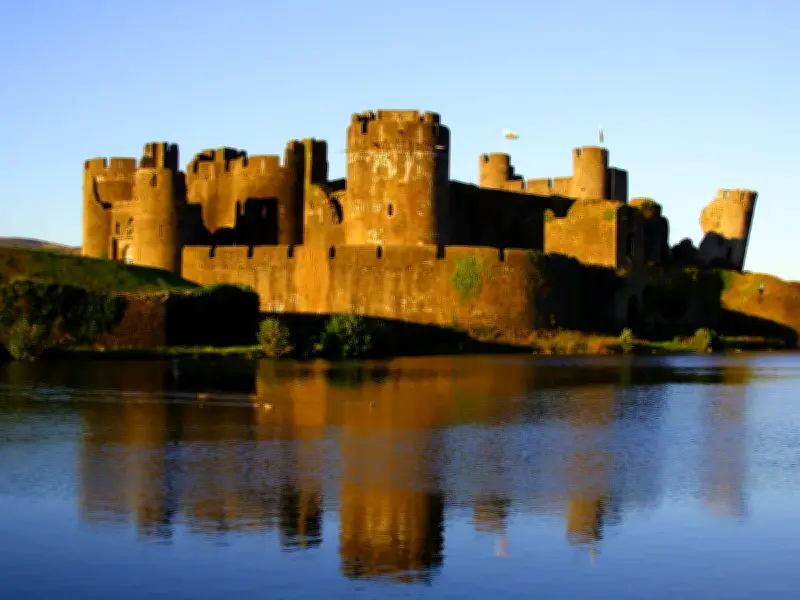
Caerphilly Castle, Wales' biggest castle, is one of the best days out in the country. It is accessible within 30 minutes of Cardiff by train or car and is visually impressive, with a huge moat and lake in front of it that makes it look like it's floating.
The famous leaning tower is its signature feature, photographed millions of times over the decades. Its location in the centre of the town, surrounded by shops, cafes and terraced streets, makes it charmingly unique. It is a top recommendation for visitors from abroad.
History and Construction
Built in the 13th century, Caerphilly Castle was initially constructed by Gilbert de Clare as part of his plans to keep control of Glamorgan, the most populated and industrialised county in Wales. Building commenced in 1268 on what was the biggest castle in the country and second only to Windsor Castle in the UK. Stretching over 30 acres with huge walls, gatehouses and water defences, it is three times the size of the Principality Stadium.

The castle has drawn comparisons to Italy's Leaning Tower of Pisa due to its own 'wonky' tower, which leans because of a blast during the Civil War in the 1600s.
Restoration and the Great Hall
The 20th century saw its restoration thanks to the wealth of the 4th Marquess of Bute. His family were responsible for turning Cardiff into a major world force of coal exports. The third Marquess had restored Cardiff Castle and Castell Coch, but his son turned his attention to Caerphilly, driven by a sense of social justice after the General Strike of 1926 and the Great Depression. By 1936 he had spent more than £100,000 from his own pocket, clearing ivy, dredging moats and restoring bridges, towers and gatehouses. Half of what we see today at Caerphilly is down to him.
The Great Hall has recently undergone a revamp. Previously a plain space, the giant hall has been decorated to reflect its medieval heyday, and with digital enhancements, visitors can be transported back to the 1320s when a royal feast was hosted there. Stonemasons, archaeologists and conservation experts were brought together to investigate and preserve the history of the castle.
Visiting Information
Cadw has also conserved and opened the medieval water-gate passageway connecting the hall to the southern lake, and carried out repairs to the Inner East Gatehouse. There are regular events during school holidays, Christmas and Halloween, including sleeping dragons.
Trains run from Cardiff to Caerphilly all day, taking around 20 minutes. Transport for Wales lets kids under 16 travel for free (up to two) with a fee-paying adult. For bus services, ring Traveline Cymru on 0800 464 0000. There are short and long stay car parks; the short stay is about 110m away, and the long stay is about 500m away.