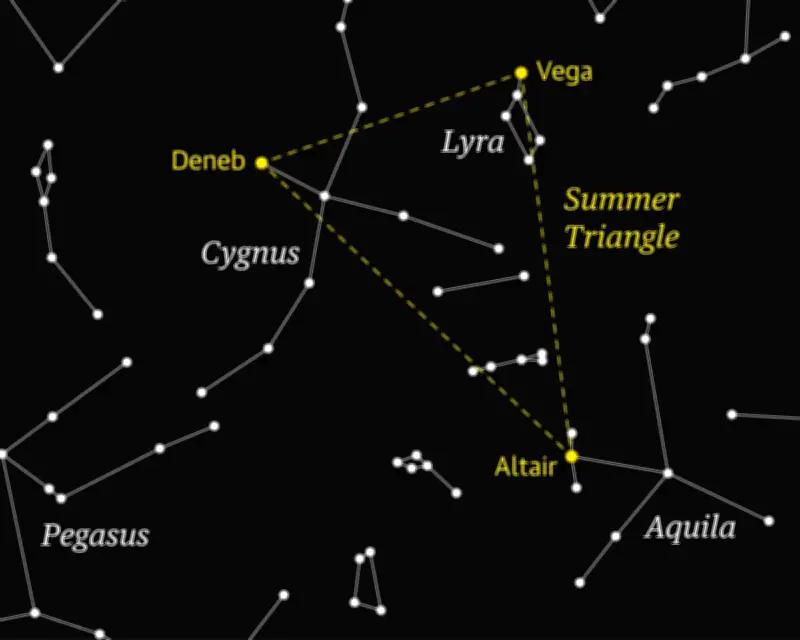
The summer triangle appears overhead in the northern hemisphere, signalling the arrival of summer. Though not an official constellation, it is one of the easiest patterns to spot in the northern summer sky.
The three stars
The view from London shows the triangle high in the south-east at 11pm UK time on 27 July. It remains essentially unchanged all week, climbing higher as the evening progresses. The brightest of its three stars is Vega, in Lyra, the lyre. Vega is almost overhead from the UK at this time of year. North-east from Vega lies Deneb, the brightest star in Cygnus, the swan. Lower in the south-east is Altair, in Aquila, the eagle.
Visibility and observation
The summer triangle frames the northern Milky Way. From a dark site, the Milky Way appears as a pale band of light running across the sky, the combined glow of billions of stars in our galaxy. From the southern hemisphere, the summer triangle is also visible but appears in the northern sky and never climbs high. For those in the north, binoculars reveal rich star fields within its confines.