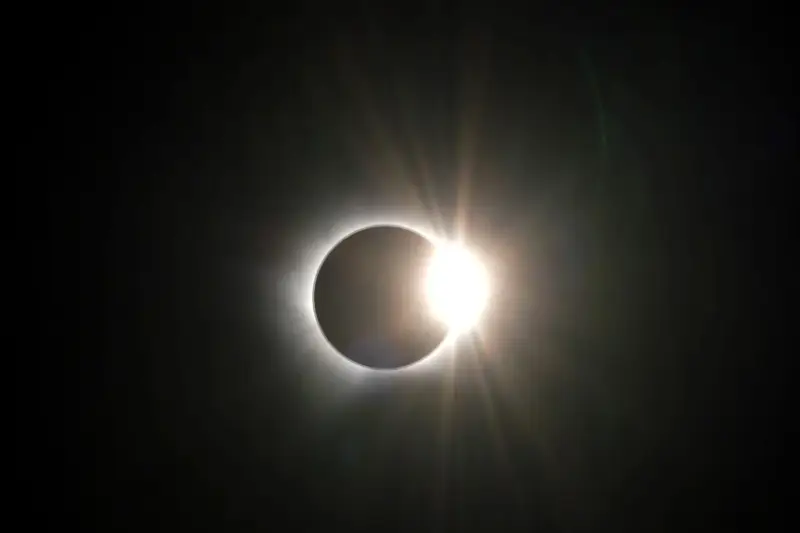
Crowds gathered at viewing spots across the UK on Wednesday evening, including the Royal Observatory Greenwich in London, Calton Hill in Edinburgh, and outside Queen's University in Belfast, to witness the best solar eclipse in decades.
More than 90% of the Sun is set to be obscured by the Moon, the most it has been blocked above UK skies since the total eclipse in 1999. People could be seen with special glasses, homemade viewers made from cereal boxes and colanders, while photographers brought cameras.
Emotional event
Dhara Patel, a space expert at the National Space Centre, said some people may be overcome by emotion while watching the eclipse. Speaking at the UK's largest space attraction in Leicester, she told the Press Association: "For a lot of people, it can be a little bit of an emotional event."
"I've seen previously people being drawn to tears or just have a really good moment within themselves where they realise they're seeing or witnessing something… you've never seen before in your life," she added. She described it as "incredible" to witness this eclipse, noting that recent solar eclipses had only about 30% coverage.
Glasses and colanders
Convenience stores, national parks and the Royal Greenwich Observatory all exhausted their glasses supplies ahead of the eclipse, which will be the country's fullest for the next 54 years. The Royal Greenwich Observatory said it had sold approximately 15,000 pairs of eclipse glasses in the last month.
John Lewis said colander sales have increased nearly 40% compared to last year, as Nasa recommends the kitchen item as a way to watch the eclipse by viewing the shadows it casts on the ground. A spokesperson said: "Colander sales have surged nearly 40% compared to last year, as shoppers prepare for tonight's eclipse."
Imo Bell, a planetarium astronomer at the Royal Greenwich Observatory, said: "You can project the image of the eclipse using a household item like a colander which has lots of holes in, point the colander towards the sun with your back facing it, and in the shadow of the colander you'll be able to see the eclipse in the holes, which is really cool."
Safety and coverage
Experts said only special solar eclipse glasses that are ISO 12312-2 certified for the safest eye protection should be used, and sunglasses are not sufficient. Following the 1999 total solar eclipse, the Royal College of Ophthalmologists reported around 70 cases of people experiencing vision problems after watching the eclipse, with around 40% having looked at it for less than a minute.
Devon, Cornwall and the westernmost parts of Pembrokeshire in Wales are set to see the eclipse at its fullest, with 94% to 96% of the sun obscured. Plymouth is forecast to see the Moon cover 94.66% of the sun at 7.16pm, according to the Met Office. Cardiff will see 93.24% at 7.13pm, and Belfast 93.09% at 7.08pm.
Skygazers in the rest of the UK will likely see 90% to 92% coverage, with 91.79% expected in Birmingham at 7.12pm, 91.41% in London at 7.13pm, 90.74% in Inverness at 7.03pm, 90.71% in Edinburgh at 7.06pm, and 90.22% in Newcastle at 7.07pm. The easternmost parts, including Norfolk, Yorkshire, Aberdeenshire, and the Orkney and Shetland Islands, will see only 88% to 90% coverage.
The annual Perseid meteor shower reaches its peak on the night of August 12-13, hours after the eclipse, produced as Earth ploughs through dust left by Comet Swift–Tuttle. Each grain strikes the atmosphere at about 60 kilometres per second, burning up in a flash.
The National Energy System Operator (Neso) has cancelled its call to the industry to generate more power during the eclipse. A Neso spokesman said the notice had been issued "as a precautionary measure to the market due to the solar eclipse", adding: "To be clear, there is no risk to customer electricity supplies."
Drivers are being warned they may need to turn on their headlights during the eclipse. RAC head of policy Simon Williams said: "While total darkness is unlikely, those with vehicles that don't have automatic headlights or daylight running lights may need to switch on their dipped beams to ensure they are easily visible to other road users."