Use our postcode search tool to find out the precise moment the moon begins to cross the sun from your location, as well as when the eclipse reaches its maximum point in your area. The most significant solar eclipse of this century will be visible across the entire UK on Wednesday, with more than 90 per cent of the sun obscured at its peak from approximately 7pm.
Eclipse timing and speed
The peak moment will take just 15 minutes to travel from the far north of Scotland down to Land's End in Cornwall, meaning the moon's shadow will race across Britain at close to 2,500 miles per hour. By entering your postcode into our interactive tool, you can ensure you are looking skyward at exactly the right moment as it passes over your home.
Unlike parts of Spain, UK viewers will not experience a total eclipse on this occasion. Astronomers are warning that staring directly at the sun remains hazardous even when more than 90 per cent of it is blocked from view.
Safe viewing and visibility forecast
Solar eclipse glasses or specialist telescopes are the only safe means of viewing the eclipse directly, although it can also be projected using a pinhole or everyday household objects such as a colander. Wednesday's solar eclipse will be the most spectacular witnessed in the nation in 54 years, and anticipation has been so high that High Street shops and online retailers have completely sold out of eclipse-viewing glasses.
The latest Met Office predictions indicate that most of England and Wales will enjoy clear skies on Wednesday evening, with temperatures expected to exceed 30C across much of the country. However, cloud cover is anticipated across most of Scotland and Northern Ireland, as well as parts of the North East of England and Cumbria. Depending on cloud thickness, the eclipse could still be visible in these regions.
Regional coverage and expert advice
The prime spots for watching the eclipse are in the far south-western corners of Devon and Cornwall, where as much as 96 per cent of the sun will be blocked out by the moon. The remainder of Wales, Northern Ireland, parts of the West Midlands and the South West, along with the most westerly parts of Scotland, can expect between 92 and 94 per cent solar coverage. In Cardiff, the moon is forecast to obscure 93.24 per cent of the sun at 7.13pm, while in Belfast it will cover 93.09 per cent at 7.08pm.
Areas further east, including the coastlines of Norfolk, Yorkshire and Aberdeenshire, will experience a slightly reduced eclipse effect — though these locations will still see just over 90 per cent of the sun covered. The Royal Greenwich Observatory has cautioned that ordinary sunglasses aren't adequate protection for viewing the celestial event.
Planetarium astronomer Imo Bell from the observatory previously told the Press Association: "It's not a total eclipse, but over 90% is really exciting. We're not going to get one this good for a really long time. So, it's important not to miss it, and to be prepared. You can't just go out and expect to have a look because it's really dangerous for your eyes."
"So, you can use solar eclipse glasses, which are very, very different from sunglasses – they block out so much light that you can't see anything through them except the sun, because that's how much light they need to block for the damaging light of the sun to be safe to view. Ideally a solar telescope is an amazing way to witness it, and if you don't have one of them then you can look into whether your local astronomy society is doing any events."
"And if all else fails, you can project the image of the eclipse using a household item like a colander which has lots of holes in – point the colander towards the Sun with your back facing it, and in the shadow of the colander you'll be able to see the eclipse in the holes, which is really cool."
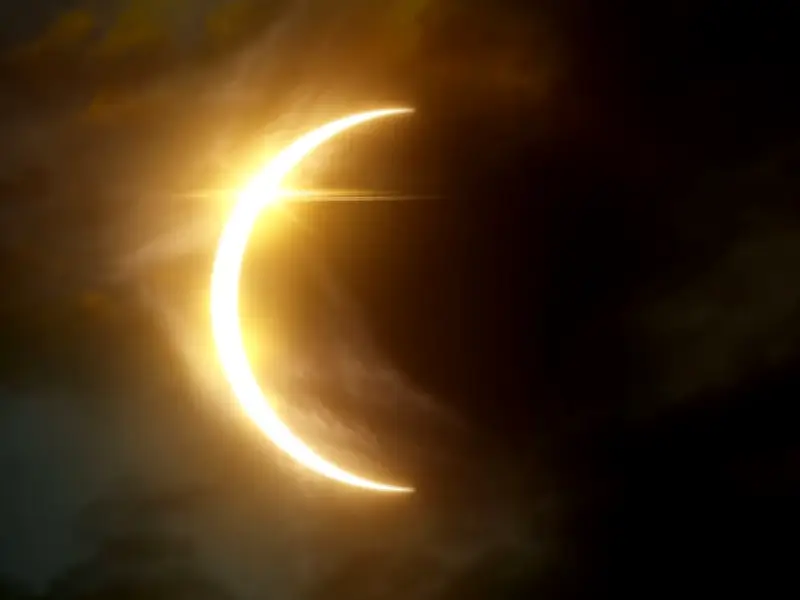
The moon won't obscure this much of the sun again until 2081, while the UK's next total solar eclipse won't occur until 2090. Ms Bell advised getting to a vantage point facing west, with minimal buildings around, as the best way to view the eclipse. "We might notice the sky getting a little bit dark, so if you're looking safely, it'll look a bit like the moon is taking a bite out of the sun, you'll see something that looks a bit like a crescent sun."