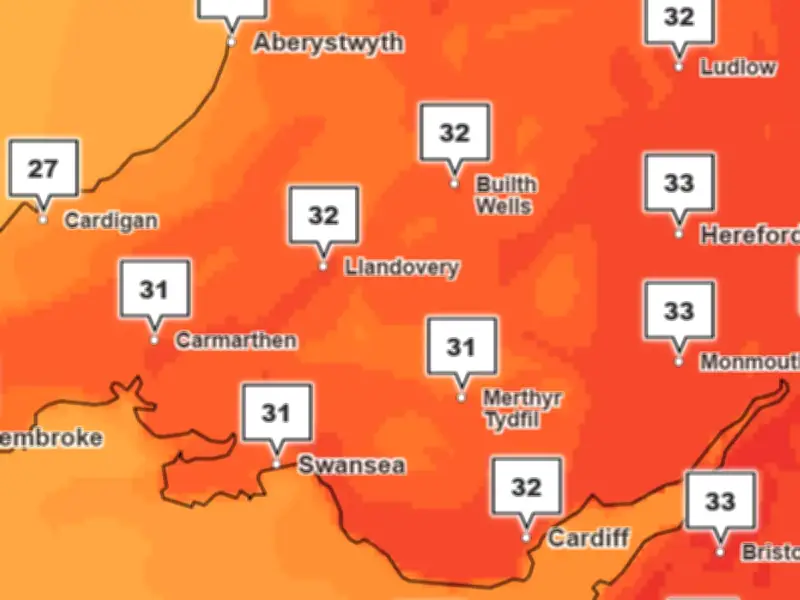
Wales is set to experience scorching temperatures this week as another burst of summer heat sweeps across the country. The Met Office forecasts temperatures will climb into the low 30s by the end of the week, peaking on Wednesday and Thursday.
Heatwave Builds from Monday
Monday marks the start of the heatwave, with sunny spells developing across much of the country. Temperatures will reach the mid-20s in places including Cardiff, Swansea, Newport and Pontypridd.
Tuesday sees the heat step up a notch, with the hottest spots in North Wales, such as Bala, reaching 29C. The south east will also be warm, with Cardiff around 29C and temperatures rising towards 30C in parts of the south and south-east.
Peak Heat on Wednesday and Thursday
The real heat arrives on Wednesday, when temperatures are expected to reach around 32C in Cardiff and potentially higher inland. Most of the country will be 30C or higher by 4pm, with cooler conditions on the west and north coasts and Anglesey.
Thursday could bring another exceptionally hot day for South Wales. Cardiff is forecast to reach around 33C, Monmouth is bracing for 34C, while temperatures around Pontypridd could climb to approximately 32C by 4pm.
Coastal areas such as Swansea are set to be nearing 30C again, while inland parts of the Vale of Glamorgan, Monmouthshire and the South Wales valleys will see temperatures exceeding the heatwave threshold for a third or fourth day.
Heatwave Threshold and Relief
The Met Office states that Wales has a heatwave threshold of 25C, with a heatwave officially recorded when a location reaches 25C or above for at least three consecutive days.
The hottest weather is expected to be concentrated across the east, while coastal areas are likely to be slightly cooler due to the influence of the sea. Friday is expected to bring some relief, although temperatures could still reach the high 20s in Cardiff, Swansea and other parts of the south.
Drought and Wildfire Risk
At the end of July, drought was declared across the nation after weeks of hot weather and very little rain. Natural Resources Wales (NRW) said Wales received only 8% of its normal rainfall during July, putting increasing pressure on wildlife, farming and the environment.
People are being asked to take extra care outdoors because the dry weather has increased the risk of wildfires. Anyone who sees a wildfire should move to a safe place and call 999 immediately.
NRW says the drought highlights the growing impact of climate change, with hotter, drier summers expected to become more common in the future.