The UK and Ireland are set to witness the most significant partial solar eclipse in nearly 30 years on August 12, with the Moon covering approximately 90% to 96% of the Sun at its peak. This will be the first partial solar eclipse visible in the region since 1999.
What to Expect During the Eclipse
A solar eclipse occurs when the Moon moves directly between the Earth and the Sun, blocking some or all of the star's light. On August 12, the eclipse will also be observable across much of Europe, including France, Belgium, Switzerland, and northern Italy, where around 88% to 95% of the Sun will be covered. In parts of Greenland, Iceland, and northern Spain, observers will experience a total solar eclipse, with the Sun entirely concealed by the Moon.
For the UK and Ireland, this will be the most substantial solar eclipse in nearly three decades. In 1999, a total eclipse was visible from parts of Cornwall and Devon, with a deep partial eclipse observed elsewhere.
Timings and Visibility
As the afternoon advances on August 12, the Moon and the Sun will appear to draw nearer together in the sky. Since the side of the Moon facing Earth is unlit, it won't be visible without special equipment. The partial solar eclipse will commence at 6.17pm in London, with slight timing variations across the UK and Ireland, when the Moon first begins to obscure the Sun.
The Moon will then steadily drift across the Sun's disc, achieving maximum coverage at 7.12pm, when roughly 90% of the Sun will be blocked. At this moment, there will be a notable reduction in light levels and temperature, though the sky won't turn completely dark as occurs during a total eclipse. Instead, conditions might mirror an overcast day or the illumination witnessed around sunrise or sunset.
Following the peak, the Moon will gradually drift away from the Sun until the eclipse concludes at 8.06pm. Since the event occurs around sunset, both the Sun and Moon will sit low in the western sky, so an elevated position with an unobstructed view of the western horizon will offer the best chance to observe the entire spectacle.
Safety Warning
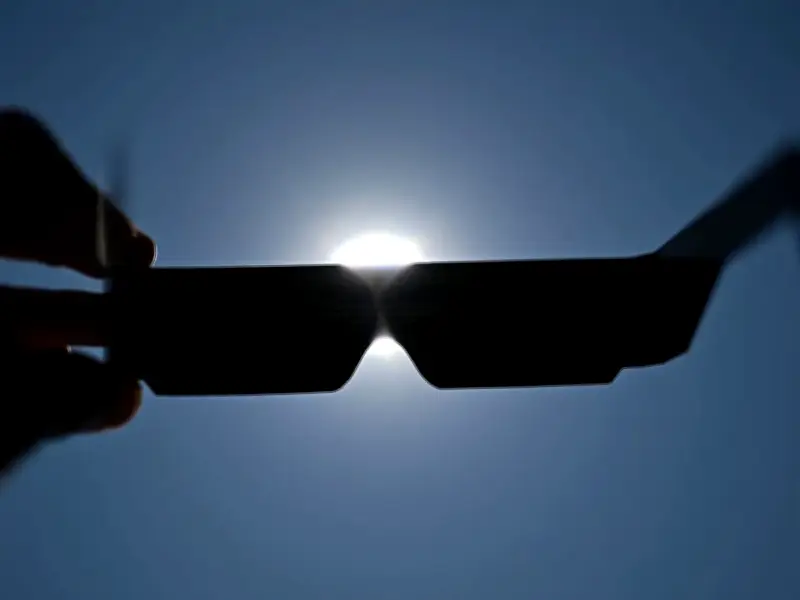
Experts have cautioned that only specialist solar eclipse glasses that are ISO 12312-2 certified for the safest eye protection should be used to observe the eclipse. Other glasses that fail to meet these safety standards, or regular sunglasses, regardless of how dark, should never be worn to view an eclipse, as they diminish glare, making it feel more comfortable to gaze at the Sun for extended periods, but still permit damaging solar radiation to reach the retina.
After the 1999 total solar eclipse, the Royal College of Ophthalmologists documented approximately 70 cases of people experiencing vision problems following eclipse watching. Around 40% had gazed at it for less than a minute.
Mohamed Elalfy, a consultant ophthalmologist and president of the Royal College of Ophthalmologists, said: "The safest way to enjoy the eclipse is to observe it indirectly, such as by watching a live broadcast. Looking directly at the Sun during a solar eclipse can cause damage to the retina, potentially damaging the cells responsible for sharp central vision. Crucially, the retina has no pain receptors, so people will not feel the damage as it happens. Symptoms may only become apparent several hours later and can include blurred vision, a central blind or dark spot, distorted vision, reduced colour perception and increased sensitivity to light. While some people recover over weeks or months, others can be left with permanent visual impairment."
Eclipse Timings Around the UK
First contact (Moon first begins to cover the Sun):
- Edinburgh & Glasgow: 6:08pm
- Galway & Dublin: 6:12pm
- Manchester & Liverpool: 6:13pm
- Norwich & Birmingham: 6:15pm
- London, Bristol & Cardiff: 6:17pm
- Truro, Cornwall: 6:18pm
Eclipse maximum (greatest coverage of the Sun):
- Edinburgh & Glasgow: 7:05pm
- Galway & Dublin: 7:10pm
- Manchester & Liverpool: 7:10pm
- Norwich & Birmingham: 7:11pm
- London, Bristol & Cardiff: 7:12pm
- Truro, Cornwall: 7:16pm
End of eclipse (Moon completely moves off the Sun):
- Edinburgh & Glasgow: 8:00pm
- Galway & Dublin: 8:05-8:06pm
- Manchester & Liverpool: 8:03-8:04pm
- Norwich & Birmingham: 8:04pm
- London, Bristol & Cardiff: 8:06pm
- Truro, Cornwall: 8:10pm