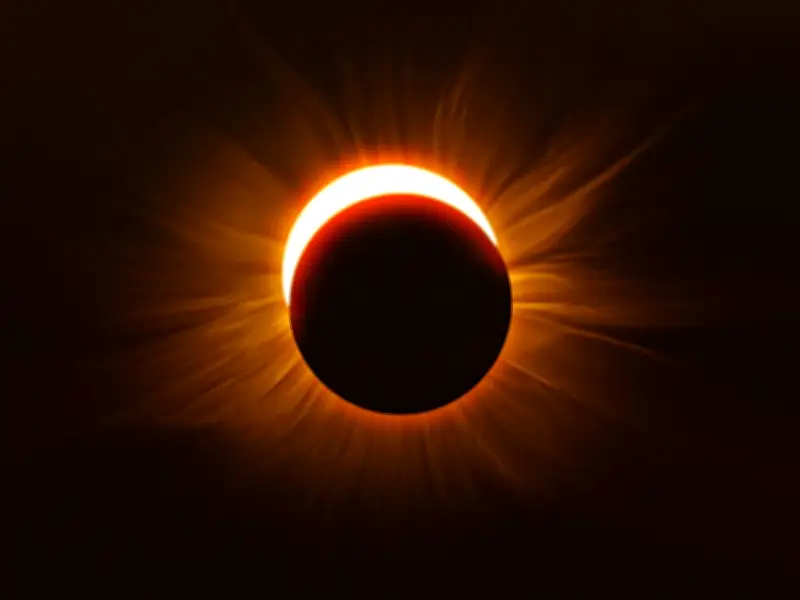
Skygazers across Scotland are gearing up for a historic partial solar eclipse tonight, the first of its kind in the UK since 1999. The Moon will pass directly between the Earth and the Sun, obscuring more than 90% of the Sun's surface, and the spectacle will not be seen again for another 54 years.
Timing and visibility
The eclipse is expected to begin at around 6.08pm and will last around two hours, concluding at 8.03pm before sunset. It will reach its peak at around 7.10pm, when around 94% of the Sun is expected to be obscured by the Moon. Because the eclipse happens shortly before sunset, the Sun will sit only around 9° to 11° above the horizon at maximum eclipse, so choosing a location with an uninterrupted view is important.
For those watching in Scotland, if the sky is clear, gazers will get to witness the sky turn dark and a bright ring of the Sun's atmosphere appear. If you can't get outside to see it for yourself, a free livestream from the Royal Museums Greenwich in London begins at 6.10pm and runs until 8pm.
Best places to watch
The Met Office has confirmed that the west of Scotland is the best location to view the solar eclipse tonight. The Western Isles and the West Coast, including Glasgow, are predicted to see the most coverage in the country, with between 92% and 94% of the Sun obscured. Inverness will see around 90.74% coverage, while Edinburgh will see 90.71% of the Sun hidden. Parts of Aberdeenshire, Orkney and Shetland may see slightly less, between 88% and 90% of the eclipse.
Once the eclipse ends, skywatchers may be treated to another celestial display. The event coincides with the peak of the Perseid meteor shower, meaning those who remain outdoors after darkness falls could also see dozens of shooting stars crossing a moonless sky.
How to watch safely
Despite most of the Sun being covered, it is never safe to look directly at a partial solar eclipse without proper eye protection. The UK Health Security Agency recommends using only genuine eclipse glasses or handheld solar viewers that meet the international safety standard ISO 12312-2:2015(E). Ordinary sunglasses do not provide enough protection.
Anyone using binoculars, cameras or telescopes should ensure they are fitted with specialist solar filters. Alternatively, a simple pinhole projector made from a piece of card allows the eclipse to be viewed safely without looking directly at the Sun.