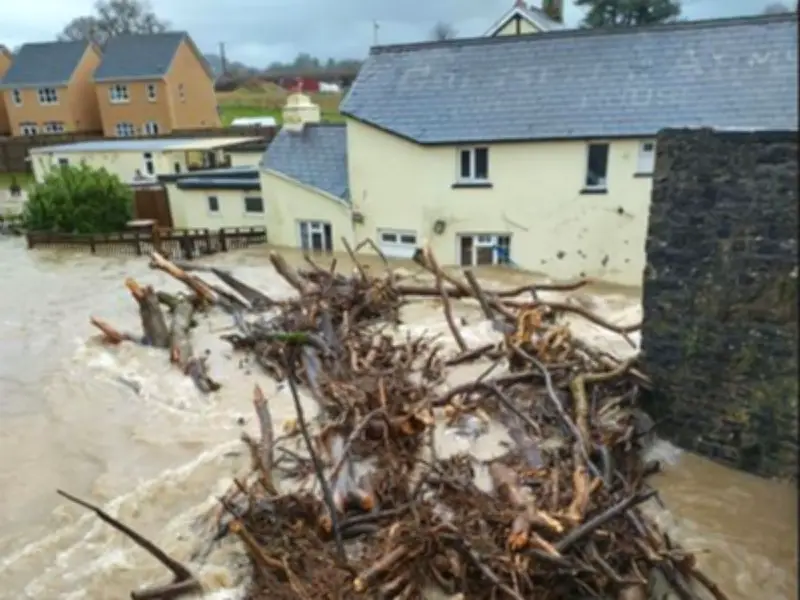
Rotating sweepers are to be installed by a river bridge in Carmarthenshire which gets clogged with debris during heavy rain. The two sweepers will be fixed to vertical steel piles five metres upstream from the grade two-listed Pontargothi Bridge.
How the Sweepers Work
The bridge has three arches and the idea is that the 1.6m diameter sweepers will deflect 60-70% of the logs and other debris away from the two stone piers, where they get jammed, downriver. Jammed logs can accumulate to such an extent that the level of the River Cothi is markedly higher upstream than downstream until they are cleared by contractors. The vertical sweepers are expected to reduce but not eliminate flood risk for surrounding properties, including The Cresselly Arms pub, which has experienced serious flooding in recent years.
Carmarthenshire Council’s planning committee unanimously approved the application – believed to be the first of its kind in the UK – at a meeting on July 30. A committee report said the rotating sweepers were one of nine options originally looked at by applicant South Wales Trunk Road Agent. Experts went on to consider four potential locations to install them. Modelling and testing then took place in a laboratory.
Objections and Concerns
Council planning officer Helen Rice said the scheme before the committee had been more than five years in the making and would be subject to a management and maintenance plan. “From our perspective, what has been suggested will result in a reduction of 60-70% of debris in front of the bridge,” she said.
There were six objections raising concerns that the proposal was geared towards protecting the bridge rather than decreasing flood risk for properties. Its effectiveness during really high flow rates was also questioned, along with potential vibration impacts on nearby buildings. Objectors were also worried that children swimming in the river might try to climb the sweepers and injure themselves.
Ward councillor Mansel Charles said flooding had caused a lot of damage in Pontargothi and that many residents wanted shale on the riverbed removed and a barrage installed further upstream to catch floating logs and trees. According to councillor Charles a lot of requests had been made to environment body Natural Resources Wales to clear riverbed shale and turned down. Cllr Charles said he understood the sweeper project would cost £1 million. “Local people are not convinced that this scheme will help them,” he said.
Councillor Dorian Williams said flooding had taken place in his Llanboidy ward which never used to happen due to accumulating riverbed shale. “The riverbed is where the problem lies,” he said. Cllr Denise Owen wanted to know where the debris directed between the bridge arches would end up.
Ms Rice said the scheme aimed to both protected the listed bridge, which supports the A40, and help residents at risk of flooding. She added that the debris would continue downstream and then into the River Towy and that there weren’t many further pinch-points en route. Councillors heard that scour protection work would also take place to protect an existing concrete “apron” on the riverbed at the bridge. A CCTV camera will be installed on the east bank of the Cothi plus equipment allowing river levels to be monitored remotely.
A Resident's Experience
Pontargothi resident Claire Gooding was flooded last November and December, leaving her contemplating spending Christmas Eve camping in her damaged home with her two daughters before heading to a friend’s house the next day. Speaking to the Local Democracy Reporting Service, she said: “I’m 43 and I don’t have a tea towel or iron to my name, let alone a birth certificate.” She described the build-up of logs at the bridge as like a beaver dam. “Nobody wants to take responsibility,” she said.
Reacting to the planning approval she said: “They are doing something rather than nothing, which is great. The sooner the better. I’m still patching my house back together bit by bit. Winter is looming – it’s in the back of my mind.”
The Cresselly Arms was also counting the cost of yet more flooding last winter. Speaking at the time tenant landlord John Davison said he had a submersible pump but no flood insurance cover. “We don’t even try,” he said. “The flooding has been well-documented.”