Lundy island, 10 miles off the coast of north Devon, is critically short of water after a dry summer, leading to visitor caps and talk of evacuating its 28 residents. No significant rain has fallen on the island since the start of May, leaving water levels perilously low.
Restrictions have been put in place, visitor numbers limited, and there has been discussion of evacuating the island, which is home to 28 people. Tom Carr, a conservation farmer who looks after sheep, cattle and ponies, said it has been a challenge. He has lived on Lundy for more than 20 years and attributes the problem to the combination of the climate emergency and the topography of the granite outcrop that rises out of the Bristol Channel.
Water levels at critical low
“Climate change is here, it’s happening. We’re having hotter, drier summers. And when the rain clouds do come in, they tend to split as they approach the island and we stay dry,” Carr said. The three-mile-long island, known for its puffins and pirate past, relies on rainwater and five boreholes. The largest rain catchment area is in the south, where water flows down to a collection tank near the harbour before being pumped to a purification plant near the old lighthouse.
Island manager Matt Scantlebury said a fortnight ago the tanks were at 13% capacity, enough water for only about a week. Tonnes of water were being brought over in 1,000-litre containers on the island boat, the MS Oldenburg, to top up the supply. The campsite, popular with climbers once the cliff-nesting seabirds have gone, was shut. Toilets at the island pub, the Marisco Tavern, were closed. Bath plugs in holiday lets, which can accommodate up to 110 people, were removed, and visitors were asked to think twice before flushing toilets.
Pond water used as backup
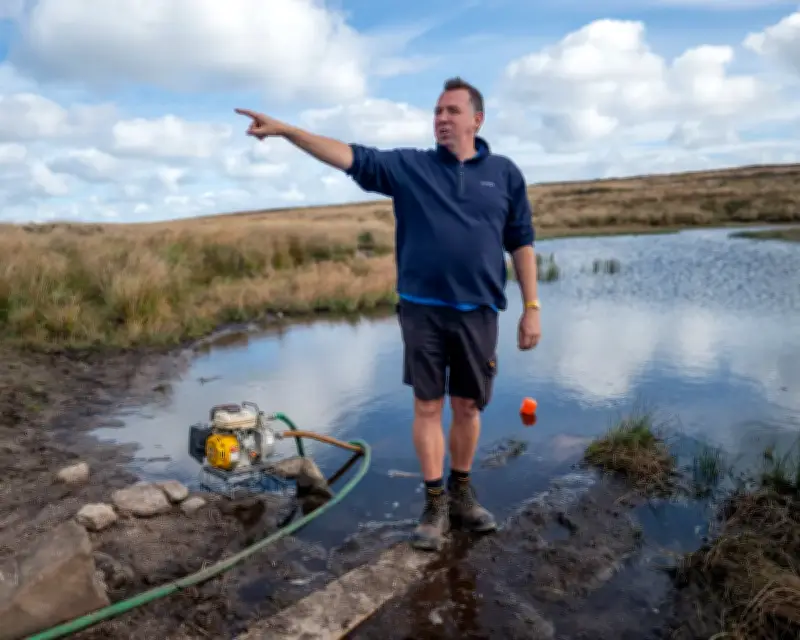
On the day the water reached its low point, the island received confirmation that water in one of its freshwater pools, called Pondsbury, was of good enough quality to be used. About 12,000 litres of water has been taken from there every day since, and levels are back up to 22.5%. But now the pond is starting to run dry. “And still no proper rain is forecast,” said Scantlebury. “We know we have to find ways of future proofing ourselves.”
A new 300,000-litre water tank has been ordered. The idea of a desalination plant has been suggested, but Scantlebury said it would be expensive and would probably need more energy than the island could produce. Tristan Howes, the island’s engineer, said conserving the little water Lundy had was crucial. “A dripping tap can lose a lot of water,” he said. A broken pipe would be a disaster.
Residents adapt and stay positive
Staff have got used to having rapid showers and catching the water in a bucket to flush the toilet. “It’s about being as efficient as we can,” Howes said. Visitors to Lundy, owned by the National Trust and managed by the Landmark Trust, tend to be the sort who don’t mind a little hardship. Michelle Phillips and her husband Fred Bullinaria arrived for a day trip with 1.6 litres of water, four Lucozades and a tube of hydration tablets in their backpacks. “I think that will keep us going,” she said.
Vick and Ed Crane were staying on Lundy for a few days to celebrate their 10th wedding anniversary. They had bought wet wipes to limit their water usage. “We don’t mind roughing it,” said Vick. “That’s part of the Lundy experience. It’s an adventure.”
Tara McEvoy-Wilding, assistant warden on the island, said some creatures had done well from the hot summer. “It’s been a good year for butterflies and moths.” It has also been a good summer for the Lundy cabbage, a primitive brassica that grows only on the island. “It’s quite a pioneering species and likes dry bare ground where there isn’t much vegetation,” she said. “Hundreds of tiny cabbage plants have started to establish in areas where they wouldn’t normally. So that’s positive, at least.”
McEvoy-Wilding said residents had become accustomed to using less water. “You’re more mindful – you only have a short shower and you don’t always flush the toilet. In a way it’s not a bad thing. It makes you think about how much water you could be saving every day by just making very small changes.” But she is still hoping for rain. “It’s amazing how little rain we’ve had. We had one day in August when it rained for an hour. Absolutely torrential. I was caught in it and got drenched but the ground was so dry it just poured off the island. I’ve got an allotment and it’s been hard to keep my vegetables alive. The pumpkins aren’t anywhere near as big as normal. Some nice, steady rain would be perfect.”