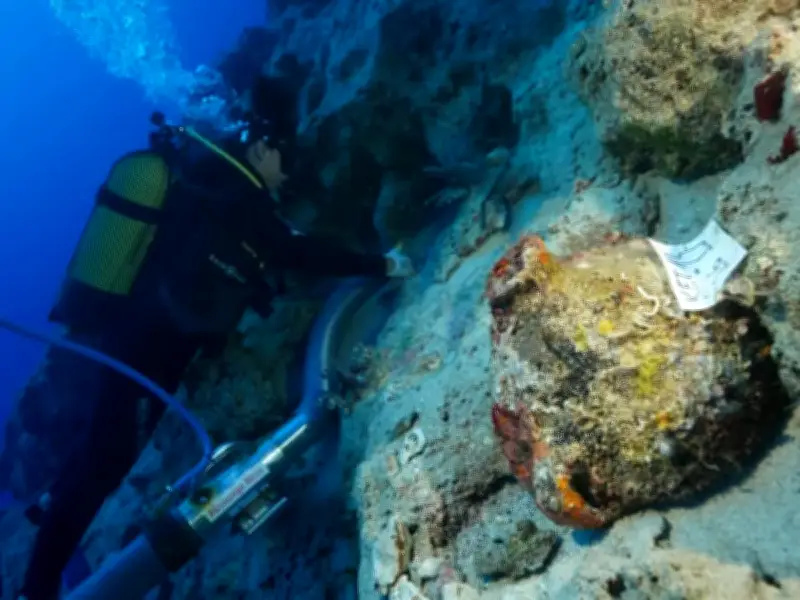
The world's oldest-known shipwreck has been discovered off the coast of Turkey, which archaeologists have dated back 4,400 to 4,700 years ago. The ship was dated to the Early Bronze Age and is believed to have been built around the same time as the construction of the Great Pyramid.
Discovery off Kekova Island
The wreck was discovered off the coast of Kekova Island, in Antalya, southern Turkey. The ship was around 10m long, according to the researchers from Mediterranean Archaeology Association who made the discovery. Archaeologists found artefacts on an underwater slope, 30m deep into the sea. Some of the items retrieved included 30 ceramic pots and three large stone anchors.
Despite the wooden structure of the ship not surviving, archaeologists were able to date the discovery to 2600-2400 BC, making it the oldest discovered shipwreck in the world. A study of the discovery, in the Journal of Maritime Archaeology, said: "Current information suggests that the shipwreck is from a small vessel that sank while sailing east to west during the Early Bronze Age."
Ceramic pots and their contents
The wooden structure of the ship had not survived but ceramic pots carried on the ship were remarkably discovered on the sea floor. Some of these pots incredibly even included traces of what they held inside thousands of years ago. Researchers said they believe the wreck could have been a trade vessel that was carrying goods across the Mediterranean Sea.
Researchers dated the wreck by analysing the shape of the ceramic pots, called amphorae, as different styles link to different periods of time. These pots had two handles on either side, a flat base and ridge in the middle. The expedition was led by Prof Hakan Öniz, from Akdeniz University in Turkey, and he said that matched the pottery styles from the Early Bronze Age popular in the Levant - modern-day Syria, Lebanon, Palestine and Israel.
Experts examine the artefacts
Prof Öniz said: "Comparing the decoration techniques… we can definitely say our wreck is Early Bronze Age. This is 100%" He added: "The shipwreck is a time capsule at the bottom of the sea."
The pots were brought out of the water by divers and the artefacts are now being conserved by experts. Archaeologist Dr Karin Sowada, from Macquarie University, Australia, looked at the amphorae after they were recovered. Dr Sowada said she was shocked to see the pots still contained a viscous, glossy residue, according to the BBC. She said: "I looked inside and nearly fainted. I could not believe how much [residue] was visible. It wasn't just like spots…. a lot of this material was still remaining."
Experts are now examining what the pots could have been used for as Dr Sowada suggested they could have carried wine, olive oil or tree resins. She added: "It's possible that [the residue] could actually be the result of reuse of the jars. I mean, these jars are huge - they're not things that you just ship away and then never see again. People would have emptied these jars on arrival and potentially used them for many, many, many years."