
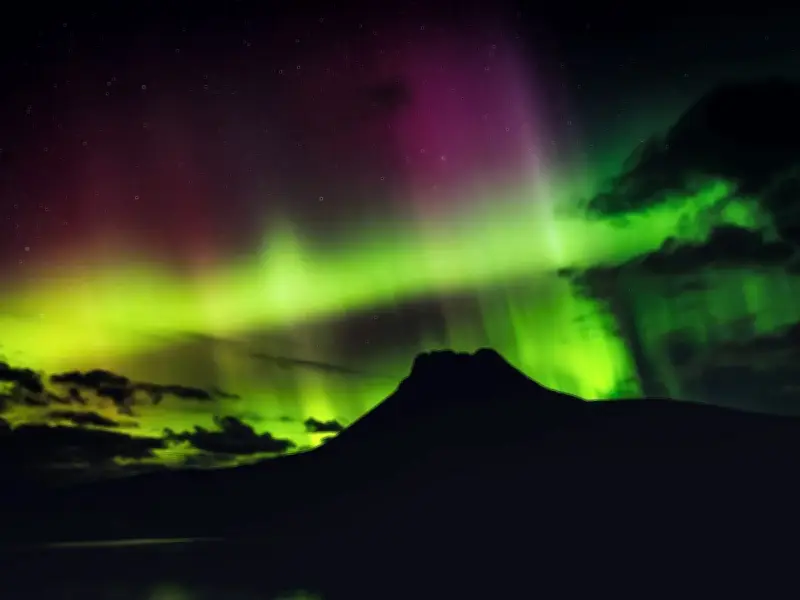
The Met Office has said the Northern Lights may be visible across Scotland on Monday night, with sightings potentially stronger than the display seen on Sunday.
Some Scots saw a dazzling Aurora Borealis on Sunday evening (Oct 11), with reports coming in from Greenock to Stirlingshire and Edinburgh. According to the Met Office's space forecast, the natural phenomenon could appear again on Monday (Oct 12) in an even 'stronger' presence.
Stronger display expected in central areas
Senior Operational Meteorologist Greg Dewhurst said the Northern Lights will be more intense on Monday, potentially offering another spectacular light show. He said: "They may be a little stronger again Monday night so could be seen further south into central areas."
He added: "Long exposure camera shots may show something each night a little further south than the above visible by eye forecast."
The Met Office's space forecast, issued on Monday, said: "Glancing coronal mass ejections followed by a coronal hole high speed stream bring a daily chance of enhancing the auroral oval, with sightings possible across Scotland and similar geomagnetic latitudes where skies are clear between 12-14 Oct."
Best locations for viewing
STV meteorologist Sean Batty echoed this, stating the Northern Lights could be visible in the UK again on Monday night. On Sunday night, the best spots were in the north and east of the country, and it seems it will be the case again tonight.
According to the AuroraMe mobile app, a tracking platform used to forecast and monitor the Northern Lights, the far north and north east of Scotland have the best chances of seeing the Aurora Borealis tonight. Named locations with good odds of visibility include the Shetland Islands, Orkney Islands, Caithness, Cairngorms, Perthshire, Aberdeen and Dundee.
In the west, those living in the Highlands, Skye or Oban may also catch a glimpse, according to AuroraMe. Across the Central Belt, visibility odds are reduced but may be possible during clear skies. The app advises: "Find a dark location with a clear northern horizon."
Why the aurora occurs
The aurora was caused by a Coronal Mass Ejection (CME), a phenomenon where the Sun releases massive clouds of particles that interact with Earth's atmosphere. The captivating colours are created when solar particles collide with oxygen and nitrogen gases in our atmosphere.
Oxygen atoms produce a striking green glow, the colour most commonly linked with the Aurora Borealis, while nitrogen atoms create shades of purple, blue, and pink. The optimal conditions for viewing occur when skies are dark and free from cloud cover and light pollution, particularly in remote locations with clear views of the northern horizon.




