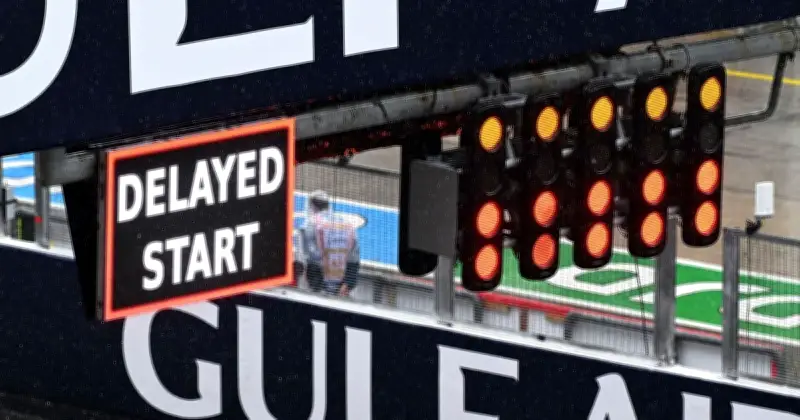
The FIA has issued a statement detailing the “unprecedented combination” of circumstances that forced race control to abort the start of the Bahrain Grand Prix in Malaysia. The race had already been delayed significantly by heavy rain that began around 45 minutes before the scheduled start time, but further problems arose even after the worst of the showers had stopped.
Formation lap chaos
With the track still wet and treacherous in places, the safety car led the pack out for a formation lap. However, Max Verstappen was the first to complain that he could not accelerate, despite being directly behind the safety car. The rest of the pack were crawling as a result, and Lewis Hamilton said over the radio to his Ferrari team: “I'm pressing the throttle and nothing is happening.”
Hamilton then pulled over at the side of the track, and it looked as though his day might have been done. Luckily, he was able to fire up the car again, as were several others who also had to stop with similar issues. The start procedure was then aborted, as too many cars had moved out of order.
FIA statement and software fix
After everyone returned to the pit lane, there was another lengthy delay while new software was distributed to teams from the FIA to try to fix the problem. In any case, the track was much drier by the time they tried to get the race started again, and from there the afternoon went without a hitch—at least in terms of the cars being able to physically operate in the conditions.
The FIA has now released a statement explaining what went wrong and what the governing body did to resolve the problem. It read: “On the formation lap ahead of the Bahrain Grand Prix in Malaysia, an unprecedented combination of low engine speed, low-grip conditions, wet-weather energy management settings and the Sepang circuit's sector configuration led to an unintended loss of power for a number of cars.
“As a result, the FIA Technical Department removed the energy limit constraint in the affected sectors through an updated software release distributed to all competitors during the race delay caused by heavy rain enabling teams to make the necessary changes to the Power Unit before the start of the race.
“This issue had not been detected by the FIA or the teams during testing or during the laps to the grid. The FIA, together with the teams and Power Unit manufacturers, will undertake a full review of the issue.”
Race restart and podium finish
At 4.33pm local, more than 90 minutes after the original start time, Verstappen peeled out of the pit-lane. Red Bull and Mercedes elected for the intermediate tyres, while Ferrari and McLaren punted for slicks. It backfired for Ferrari and McLaren. George Russell leapt from seventh to second at the start with Kimi Antonelli assuming the lead, while Hamilton, desperately struggling on the dry tyres, fell back to as far as 18th and 80 seconds behind.
Valtteri Bottas beached his Cadillac on lap nine, and a safety car was deployed. In came the leaders to change from intermediates to dry tyres, with Verstappen now ahead of Russell and in second. The Dutchman then mastered the restart to swat Antonelli aside. Russell also moved ahead of his team-mate only for Antonelli to move back past for second on lap 21.
A lengthy safety car followed late in the fixture when Alex Albon stopped and his car, stuck in gear, could not be moved by the marshals. Then, Russell's afternoon, and most likely his title bid, came to an end as his power unit gave up. But there were no such dramas for Verstappen, while Hamilton completed a fine afternoon by passing Isack Hadjar at the end to take his first podium since the British Grand Prix in July.