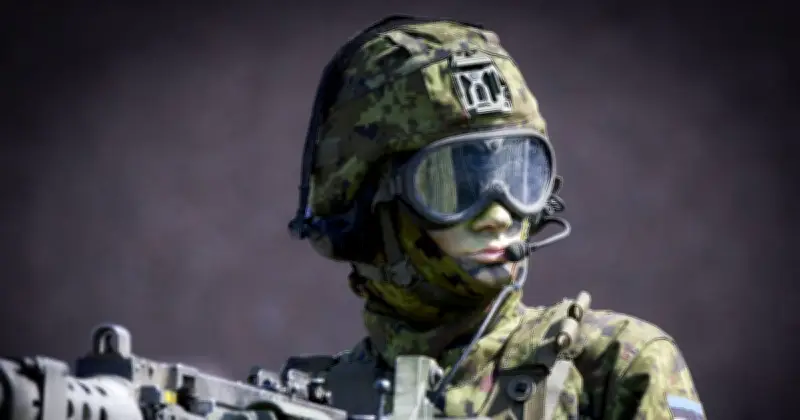
Estonia is moving its main fighting force closer to the Russian border as it prepares for the possibility of a future attack, according to the Financial Times.
The 1st Infantry Brigade is being permanently relocated from Tapa to Jõhvi, a town approximately 50 kilometres (31 miles) from the Russian border, while Tapa is roughly 130 kilometres (80 miles) away. A new base is also under construction in Narva, a city directly on the Russian border, where around 200 soldiers are expected to be permanently stationed, with space for up to 1,000 during a crisis.
NATO membership and Article 5
Estonia has been a member of NATO since 2004. Under the alliance's collective defence commitment, an attack against one member is considered an attack against them all. Other NATO countries, including Britain, would be required to assist, although each member decides what action it considers necessary.
Estonia's military and intelligence chiefs do not believe Moscow intends to launch a full-scale war against NATO within at least the next two years. However, they fear Russia could become a much bigger threat in the years that follow, particularly if troops currently fighting in Ukraine become available to move elsewhere.
Weapons and strategy
Estonia is acquiring US-made HIMARS and South Korean Chunmoo rocket systems, giving its forces weapons with ranges of up to around 300 kilometres. In case of any conflict, military chiefs want their forces to fight from the border from the beginning, rather than allowing an invading army to move into the country before trying to wear it down.
Colonel Tarmo Kundla, commander of Estonia's 1st Infantry Brigade, said: "We have to start from the border and win from the first battles."
Concerns over limited incursion
One particular concern is that Moscow could attempt a smaller incursion rather than launching a full invasion. Estonian officials fear such a move could be designed to test whether other NATO members would really come to the country's defence. However, there is currently no suggestion that a Russian attack on Estonia is imminent.
The Institute for the Study of War (ISW) suggested that Russian agents would take over major buildings in Narva as it presented a possible incursion scenario. Experts also pointed out that long-range drones could be launched from Russia.
Merili Arjakas, a research fellow at The International Centre for Defence and Security (ICDS) and the editor-in-chief of foreign policy magazine Diplomaatia, disputed the proposed sequence of events. She told the Express: "To be able to deter and, if needed, defend against any Russian attack, Estonia maintains and trains a reserve-based military force, with additional volunteers from the Defence League. We have invested a great deal of money in acquiring weaponry and ammunition for short- and long-range strikes and air defence.
"We cooperate closely with our partners for NATO’s forward presence. We also know that there is no end to the salami-slicing technique — there would be nothing ‘limited’ about a Russian incursion. Any aggressive plan against us must be disrupted or countered pre-emptively. While any security agency or military can have its blind spots, in my opinion, it would require more than just a statement ‘the military will not be able to do anything’ for an analysis to be taken credibly."