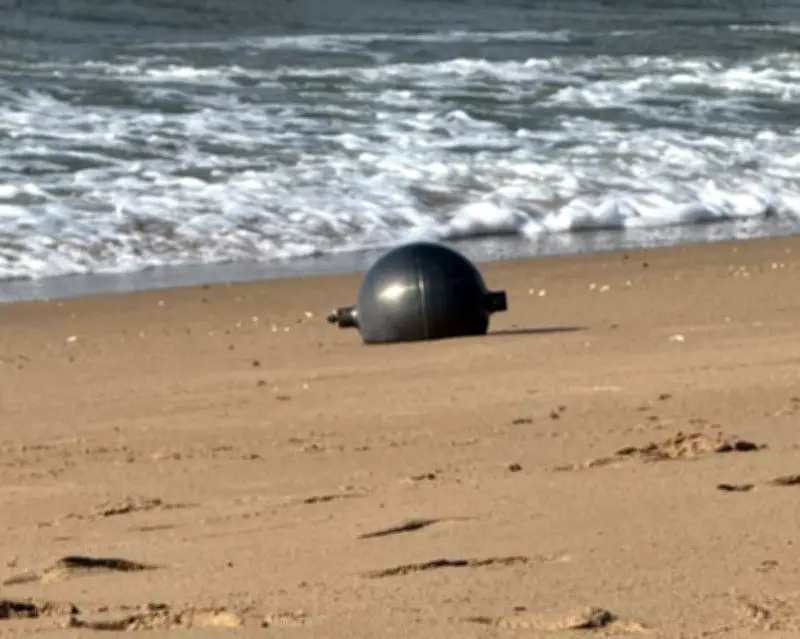
The Australian Space Agency has identified the likely origin of six mysterious objects, dubbed 'space balls', that washed ashore in north Queensland. The agency stated that the objects are consistent with debris from a foreign rocket body that recently re-entered the atmosphere from orbit.
Discovery and Initial Response
The objects were found by the public at Forrest Beach, north of Townsville, on Friday, Saturday, and Sunday. Authorities suspected they contained hazardous chemicals, prompting police and fire services to establish 50-metre exclusion zones around the debris over the weekend.
Agency Confirmation
The Australian Space Agency confirmed that the recovered objects 'appear to be pressure vessels from a space launch vehicle'. In a statement, the agency said: 'The Agency has identified the likely source. The objects' location and characteristics are consistent with debris from a foreign rocket body that recently re-entered the atmosphere from orbit.' The agency is continuing to engage with international authorities to formally confirm the launch vehicle and launching state.
Expert Analysis
Associate Professor Alice Gorman, a space archaeologist and space junk expert at Flinders University, explained that space debris falling back to Earth is governed by the 1967 United Nations Outer Space Treaty, to which Australia is a signatory. 'It's the most widely accepted space treaty where the launching state retains ownership of the launch material. This means the nation that launched them owns those pressure vessels,' she said. Australia must then negotiate with the launching state regarding the return of the debris. Gorman noted that when part of an old Indian rocket washed ashore in Western Australia in 2023, the Indian government did not request the material.
Nature of the Debris
Gorman described a pressure vessel as a container used to store fuel before it is forced into the rocket engine. Made of titanium alloy, they can withstand very high temperatures. The survival of these vessels does not necessarily indicate a rocket launch failure. 'Part of Australia's responsibility is to negotiate for the return of the space balls, if that's what the launching state wants. A launching state may want debris back to analyse if something went wrong, but if this is a standard rocket body and nothing went wrong, they probably would not need to analyse it,' she added.
Historical Context
When NASA's first space station, Skylab, fell to Earth over Western Australia in 1979, fuel tanks survived re-entry, causing sonic booms. The space agency noted that Queensland authorities have determined the objects are safe but warned that 'further debris may be found.' The agency advised: 'Never touch, move or recover suspected space debris and assume it to be hazardous until advised otherwise. Move away and contact emergency services.'
Rarity of Incidents
Gorman highlighted that only one person has ever been struck by falling space debris. In 1997, Lottie Williams was hit on the shoulder by a piece of fibreglass from a US-made Delta II rocket while walking in a park in Tulsa, Oklahoma, and was unhurt.