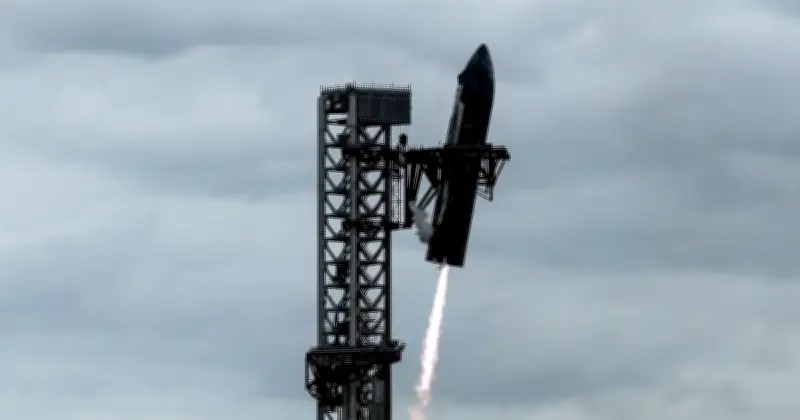
SpaceX's Starship was caught mid-air by giant mechanical arms in a historic first, though the first-stage booster exploded and fell into the Gulf of Mexico.
Historic Catch and Booster Failure
The SpaceX Starship made a spectacular return to Earth, snatched from the sky by enormous mechanical arms in the nail-biting finale that Elon Musk and his team had been banking on. It marked the first-ever capture of a Starship returning from space. However, the first-stage booster exploded shortly after Friday's lift-off from Texas, meaning the company narrowly missed its coveted double catch.
Wreckage remained in the Gulf of Mexico, cordoned off by buoys, as the stainless steel, bullet-shaped spacecraft lowered itself upright at the launch pad.
"Can you believe it?" SpaceX commentator Dan Huot shouted, dragging out each word. "Look at her! Baby, she's back!" Shortly afterwards, Mr Musk congratulated his "incredible team".
Spacecraft Performance and Reusability
SpaceX confirmed that everything aboard the spacecraft, including its critical heat shield, appeared to perform flawlessly. Officials stated that Saturday's catch demonstrates the complete reusability of Starship, which is designed for travel to the Moon and Mars.
While Friday's booster recovery proved unsuccessful, the company had already achieved three previous booster catches, firmly establishing the validity of the technique.
Nasa and Future Missions
Nasa welcomed the development, with the space agency committing billions of dollars for Starship to ferry Artemis astronauts to the Moon later this decade and assist in constructing a permanent lunar base.
Elon Musk has stated his ultimate ambition is to launch a fleet of Starships to establish a city on Mars. Nasa administrator Jared Isaacman wrote via X: "It was almost magic. Making more believers by the day ... one step closer to (emojis of the moon and the US flag)."
Flight Details and Next Steps
The world's largest and most powerful rocket — a 407ft behemoth — launched late on Friday afternoon from SpaceX's Starship facility near the US-Mexico border. The upper-stage spacecraft climbed into orbit and deployed 26 next-generation Starlink satellites.
Starship proceeded to circle the globe at 165 miles altitude, broadcasting live footage of itself and Earth via Starlink — completing 14 orbits, far surpassing the previous mission's one to two laps. This marked SpaceX's 15th full-scale Starship flight since 2023 and only its second journey to orbit.
Regarding the booster, SpaceX's Kate Tice confirmed its engines cut out prematurely during the return descent. The booster's guidance system detected an incorrect trajectory and automatically triggered an ocean diversion and self-destruction sequence. Engineers are continuing to investigate the root cause.
SpaceX anticipates commencing Starship launches from Florida's Kennedy Space Centre within the coming months. That location serves as the departure point for Nasa's forthcoming Artemis mission, which will bypass the Moon and remain in Earth's orbit for lunar lander practice. Artemis III's four astronauts will attempt to dock their capsule with both Starship and Blue Origin's Blue Moon. The two firms will alternate in transporting crews to the lunar surface. Nasa is aiming for 2028 at the earliest for Artemis IV, marking humanity's first lunar landing since the Apollo missions over 50 years ago.