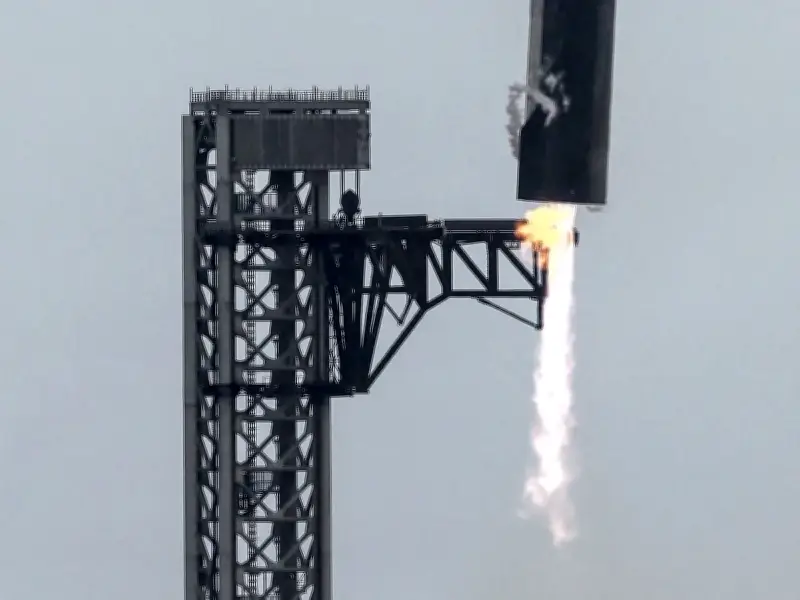
SpaceX's Starship made a dramatic return to Earth, plucked from the sky by massive mechanical arms in the nerve-wracking climax that Elon Musk and his crew had been hoping for. It represented the first-ever capture of a Starship coming back from space.
However, the first-stage booster blew up moments after Friday's launch from Texas, meaning SpaceX just missed out on its prized double catch. Debris remained in the Gulf of Mexico, sealed off by buoys, as the stainless steel, bullet-shaped craft positioned itself upright at the launch pad.
Reactions and confirmation
"Can you believe it?" SpaceX commentator Dan Huot shouted, dragging out each word. "Look at her! Baby, she's back!" Moments later, Mr Musk congratulated his "incredible team".
SpaceX confirmed that everything on the spacecraft, including its vital heat shield, seemed to work perfectly. Officials said that Saturday's catch proves the complete reusability of Starship, which is built for journeys to the Moon and Mars.
Previous booster catches and NASA support
While Friday's booster recovery wasn't successful, the company had already pulled off three previous booster catches, firmly proving the technique works.
NASA welcomed the breakthrough, with the space agency pledging billions of dollars for Starship to transport Artemis astronauts to the Moon later this decade and help build a permanent lunar base. Elon Musk has declared his ultimate goal is to send a fleet of Starships to build a city on Mars.
NASA administrator Jared Isaacman posted on X: "It was almost magic. Making more believers by the day ... one step closer to (emojis of the moon and the US flag)."
Flight details and next steps
The world's biggest and most powerful rocket - a towering 407ft giant - blasted off late on Friday afternoon from SpaceX's Starship base near the US-Mexico border. The upper-stage spacecraft soared into orbit and released 26 next-generation Starlink satellites.
Starship went on to circle the planet at an altitude of 165 miles, beaming back live footage of itself and Earth via Starlink - completing 14 orbits, vastly exceeding the previous mission's one to two laps. This represented SpaceX's 15th full-scale Starship flight since 2023 and only its second venture into orbit.
As for the booster, SpaceX's Kate Tice confirmed its engines shut down ahead of schedule during the return descent. The booster's guidance system detected a faulty trajectory and automatically triggered a diversion over the ocean and a self-destruct sequence. Engineers are still working to identify the underlying cause.
SpaceX expects to begin Starship launches from Florida's Kennedy Space Centre within the next few months. That site serves as the launchpad for NASA's upcoming Artemis mission, which will skip a Moon landing and remain in Earth's orbit for lunar lander training exercises. The four astronauts aboard Artemis III will attempt to dock their capsule with both Starship and Blue Origin's Blue Moon.
The two companies will take turns ferrying crews down to the lunar surface. NASA is targeting 2028 at the earliest for Artemis IV, which would mark mankind's first Moon landing since the Apollo missions more than 50 years ago.